


In a world of more player movement than ever in college basketball, the best teams have found success by prioritizing roster continuity. Since the introduction of free transfer movement and NIL, player loyalty has seemingly vanished. Isaac Trotter reported in March that only 22 high-major seniors played with the same team all four years.
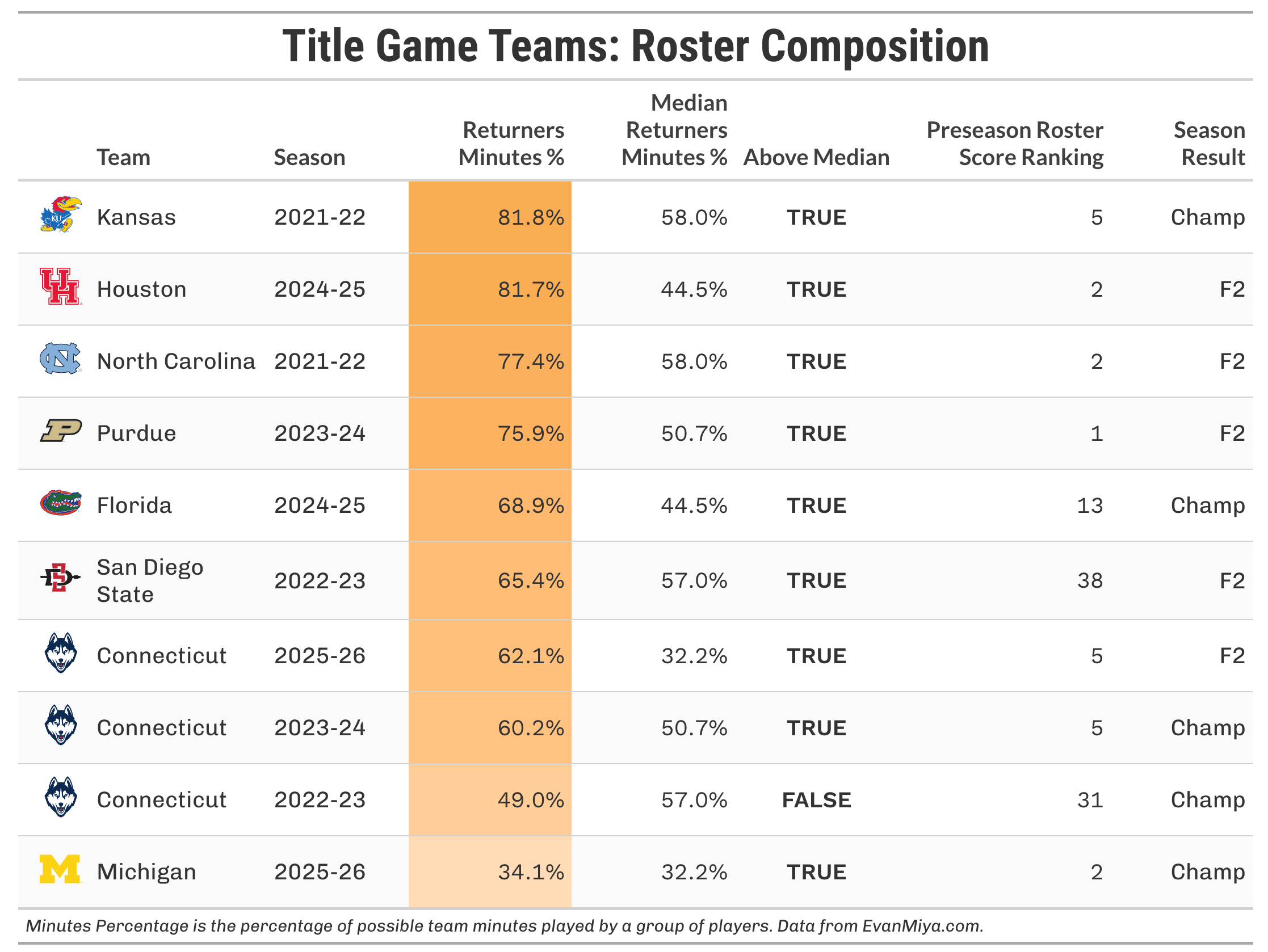
And yet, the elite teams in the sport have continued to value retention. From 2022 to 2025, every national champion had 49% or more of their minutes played by returning players, with Florida close to 70% last season.
That formula is changing.
Michigan just won a title with only 34% of their minutes played by returning players (Nimari Burnett, Roddy Gayle, Will Tschetter), while over half of their contributions came from newly acquired transfers, including their four best players (Yaxel Lendeborg, Aday Mara, Morez Johnson, Elliot Cadeau). The table below shows the sources of production for each of the last five national champions.
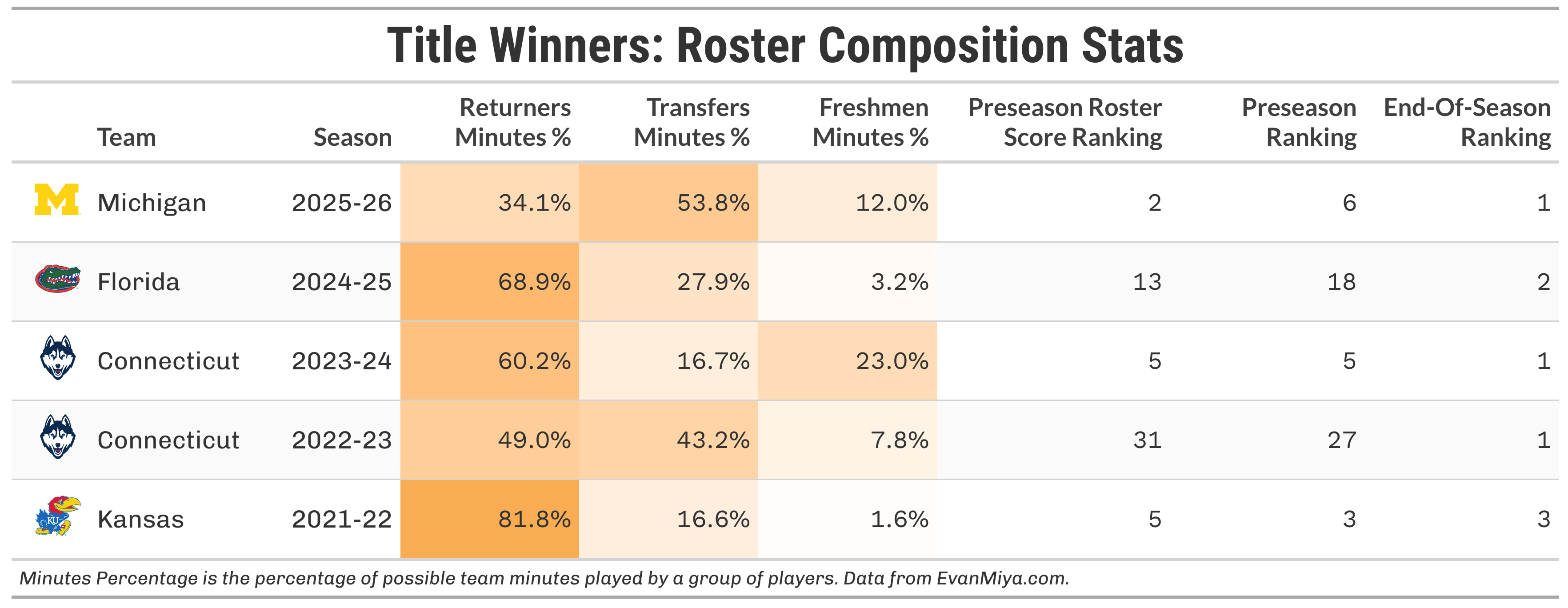
“Running it back” purely for the sake of roster continuity is not always a good thing. Perhaps the most eye-opening quote of the Final Four came when I asked Dusty May about the importance of retention today, and he reflected back on his time at FAU:
“You have to retain the right guys. We brought back our entire team after the Final Four run at FAU, and it was… the most difficult year of my life as a head coach. And so that year, it would have been much healthier for the group if we didn’t retain everyone. Retention is not always good. It’s retaining the right guys and making sure they still have the same agenda and objectives, which is to win and do it together.”
So, should teams still value roster retention? Let’s dig into the latest roster construction numbers and find out.
Chase Talent
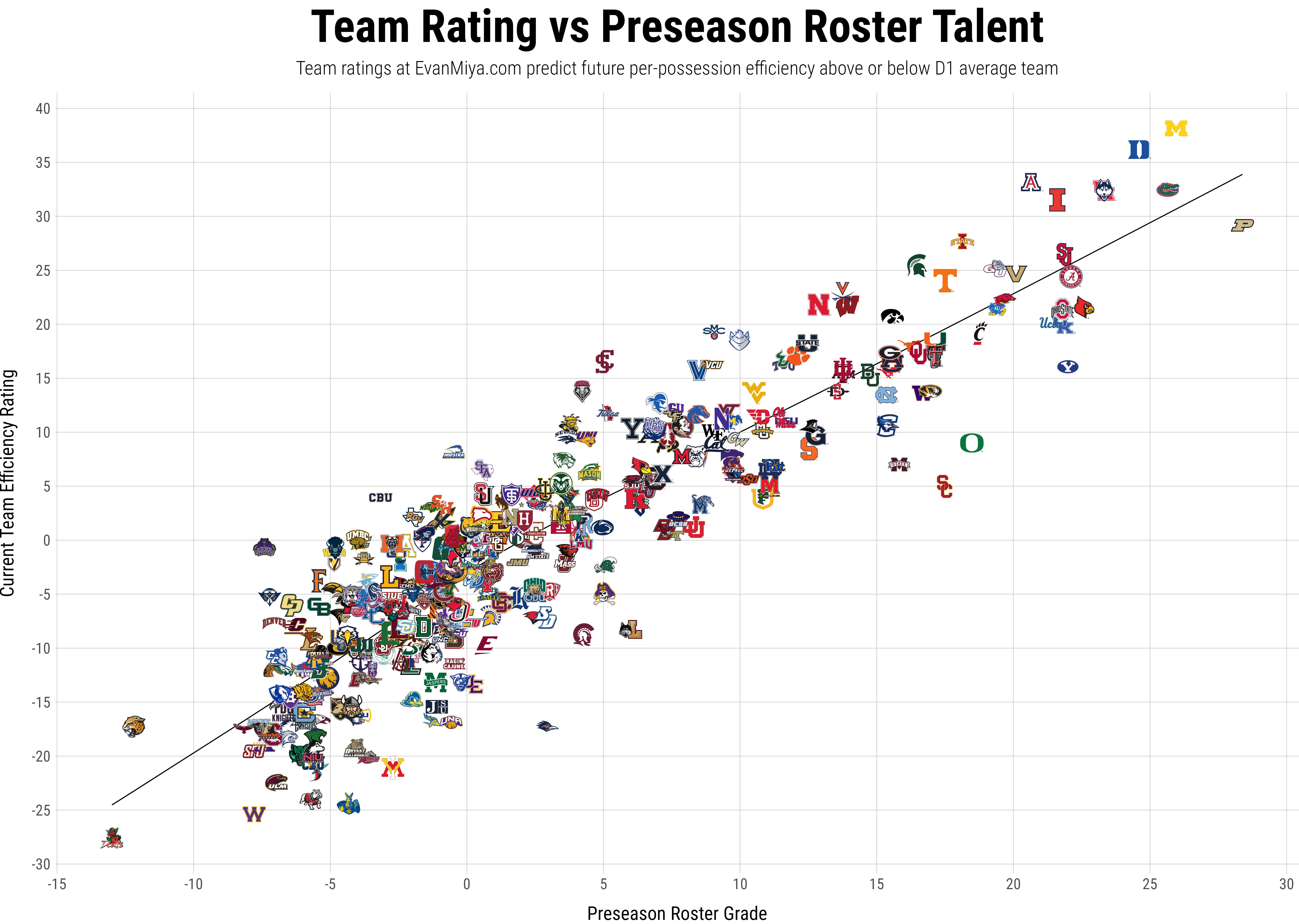
By this point, I’m beating a dead drum when I recommend that teams acquire better players. Everyone knows that you need talented rosters to be successful. However, there are fewer ways to overcome subpar roster talent than ever before. My recent article on roster talent summarized the current landscape perfectly: a team’s season is 80% defined by how good its roster is before the year even starts, with the remaining 20% accounting for everything that happens after.
The graph below shows how correlated a team’s preseason roster grade at EvanMiya.com is to how well they performed this past season. Some teams can significantly outperform their talent, but most can’t.
Roster Continuity Numbers Are Declining
Two years ago, the average high-major team allocated about 50% of its minutes to returning players, and my study showed that teams with higher roster retention performed better than other teams. Average roster continuity has dropped rapidly over the last two seasons. This past year, a typical high-major team dedicated only 32% of its minutes to returners, with 68% of its production coming from new players (incoming transfers or freshmen).
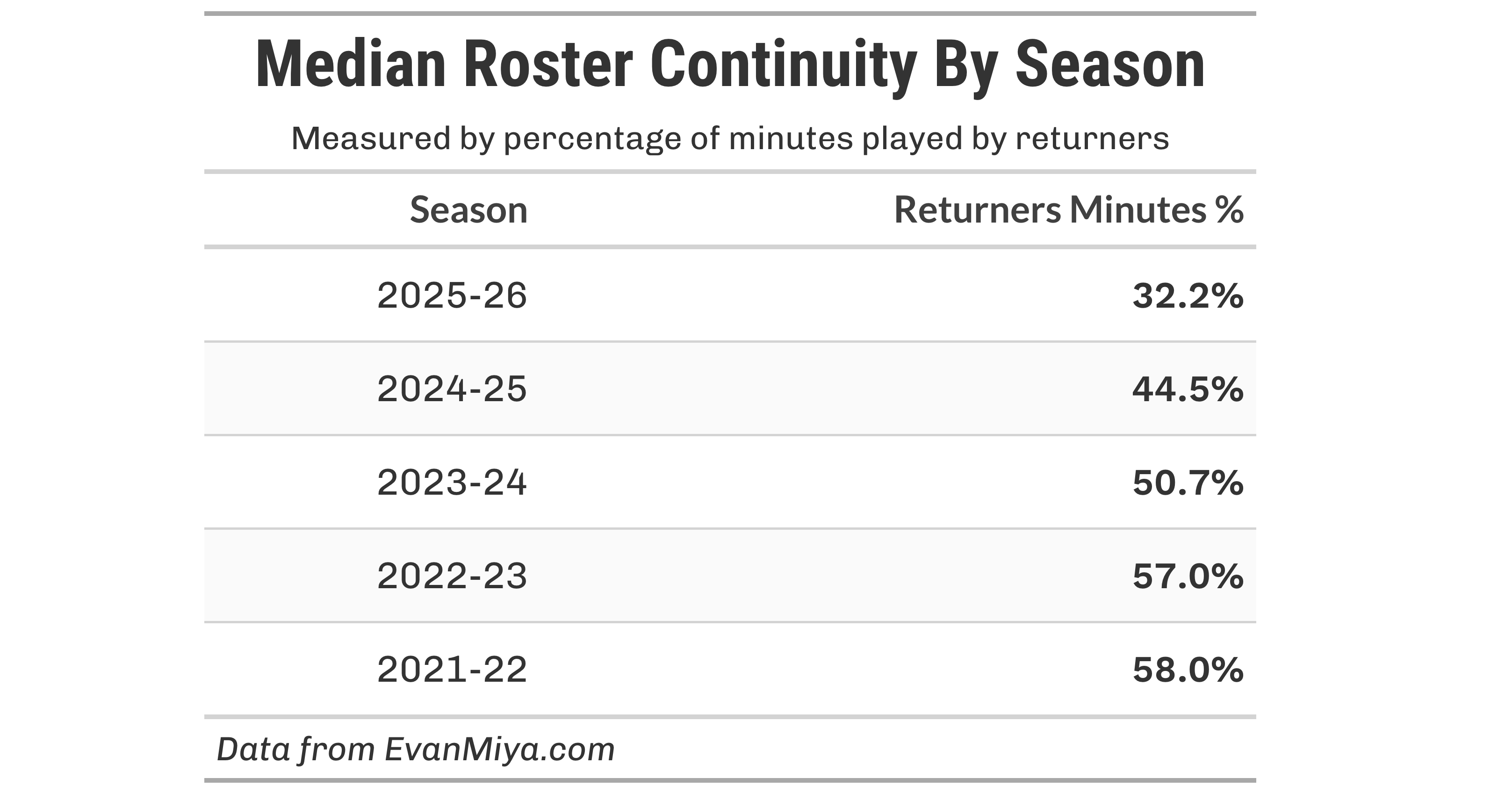
As recently as a year ago, the data showed that a team more reliant on returning players would typically outperform a similarly talented team built around newcomers.
After the 2026 season, I’ve changed my tune. There’s no longer enough evidence to suggest that a high-major team should heavily prioritize retention to have better seasons. There were many teams this year with lots of quality returning players that fell short of expectations (Purdue, UCLA, Kentucky, Missouri, Georgetown, Notre Dame, Marquette), while there were others with little continuity who did well relative to their talent level (Virginia, Miami FL, Texas A&M, Clemson). Any high-major can be successful in this age, regardless of their roster continuity, as long as they are getting more talent.
Retention Still Matters For Title Contenders
One thing hasn’t changed: Teams good enough to win a title will still typically have a higher level of roster continuity.
After studying the latest roster trends, I believe that most teams that come close to winning a title will be above-average in roster retention. All the Final Four teams in 2026 were above the median percentage of minutes played by returners, and 3 of the 4 Final Four teams the year prior were above the median for that season as well:

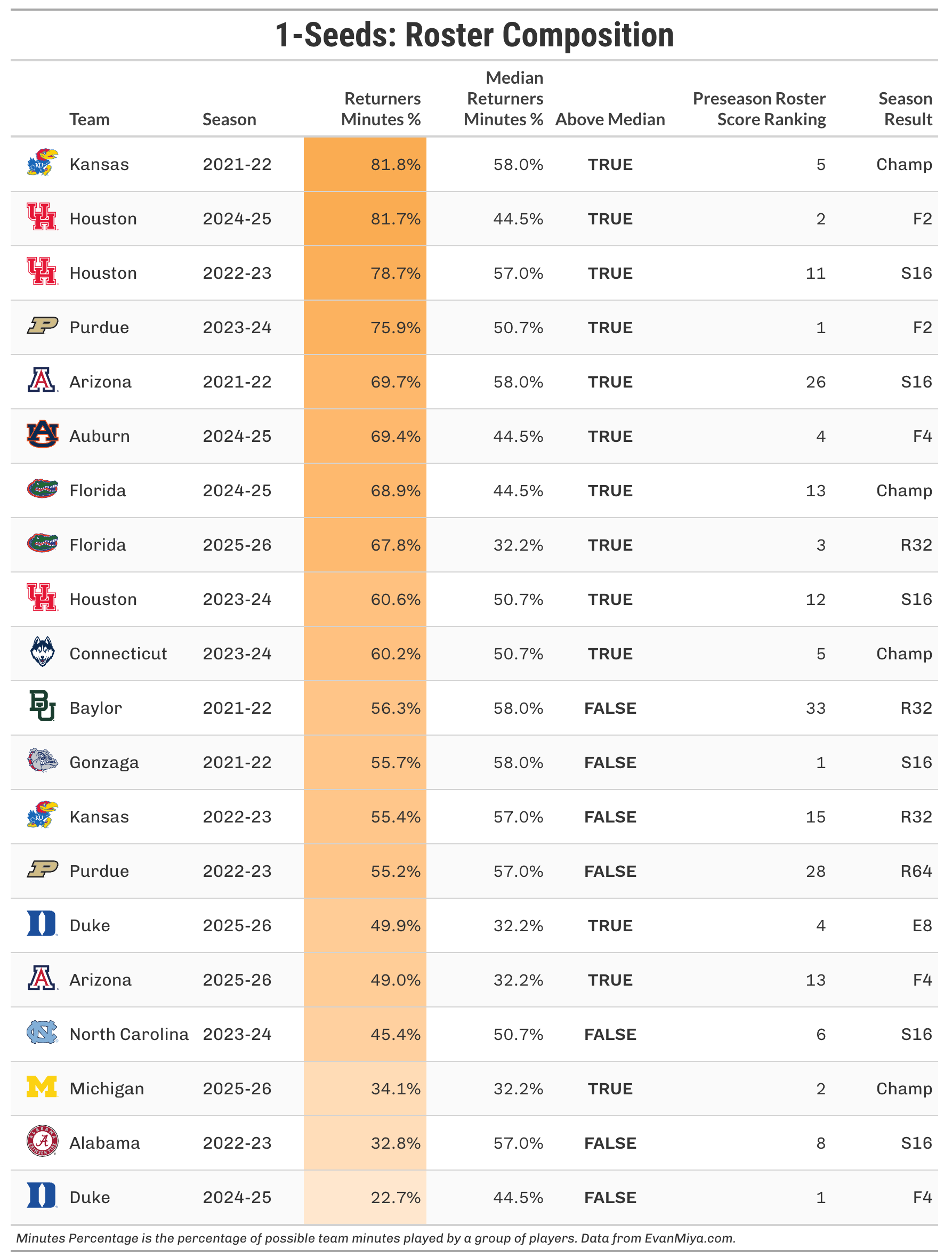
If we analyze the roster construction of all the 1-seeds from the past five seasons, two things immediately stick out: Most had really talented preseason roster grades, and most had above-average roster continuity. The table below shows the roster composition numbers for each of these teams, along with their preseason roster rankings. The median “Returners Minutes %” by year is included for comparison for each team.
Here are the three key stats from this data:
17 of the past 20 1-seeds had rosters ranked in the top-15 in the preseason. This includes all the 1s from the last three seasons. The three teams that were outside that preseason roster talent threshold didn’t advance far in the tournament (Arizona S16 in 22’, Baylor R32 in 22’, and Purdue lost to FDU in the first round in 23’).
16 of the past 20 No. 1 seeds had around half or more of their minutes played by returning players. The only two teams below 49% to get significantly far in the tournament were Michigan in 2026 (champs) and Duke in 2025 (Final Four).
10 of the 12 most recent 1-seeds have been above the high-major median in percentage of minutes played by returning players. In the last five seasons, only 24’ Duke has made a Final Four without being above the median, and that team had the most NBA talent of any team on this list.
We see similar trends if we analyze all the teams that have made the national title game over the last five seasons. Nine of the ten teams that have played for a national championship have had a higher reliance on returning players than average that season.
Added comment after publication: Now let me be clear, there’s a reason many of the best teams in the sport are able to retain a higher number of skilled players than other high-majors. Teams with larger budgets are able to keep more of their players if they choose. Still, I don’t agree with the notion that a program with a big budget can easily build a title-winning roster from scratch without retaining that many key players from the year prior.
Implications for 2026-27
There will be many teams good enough to win a national title next season, but I want to single out a few teams that meet two criteria:
Projected to have a top-10 roster
Projected to have over half their minutes played by returning players
Two teams clearly meet these thresholds next season: Florida and Illinois. Let’s dig into their rosters using the Roster Outlook tool at EvanMiya.com.
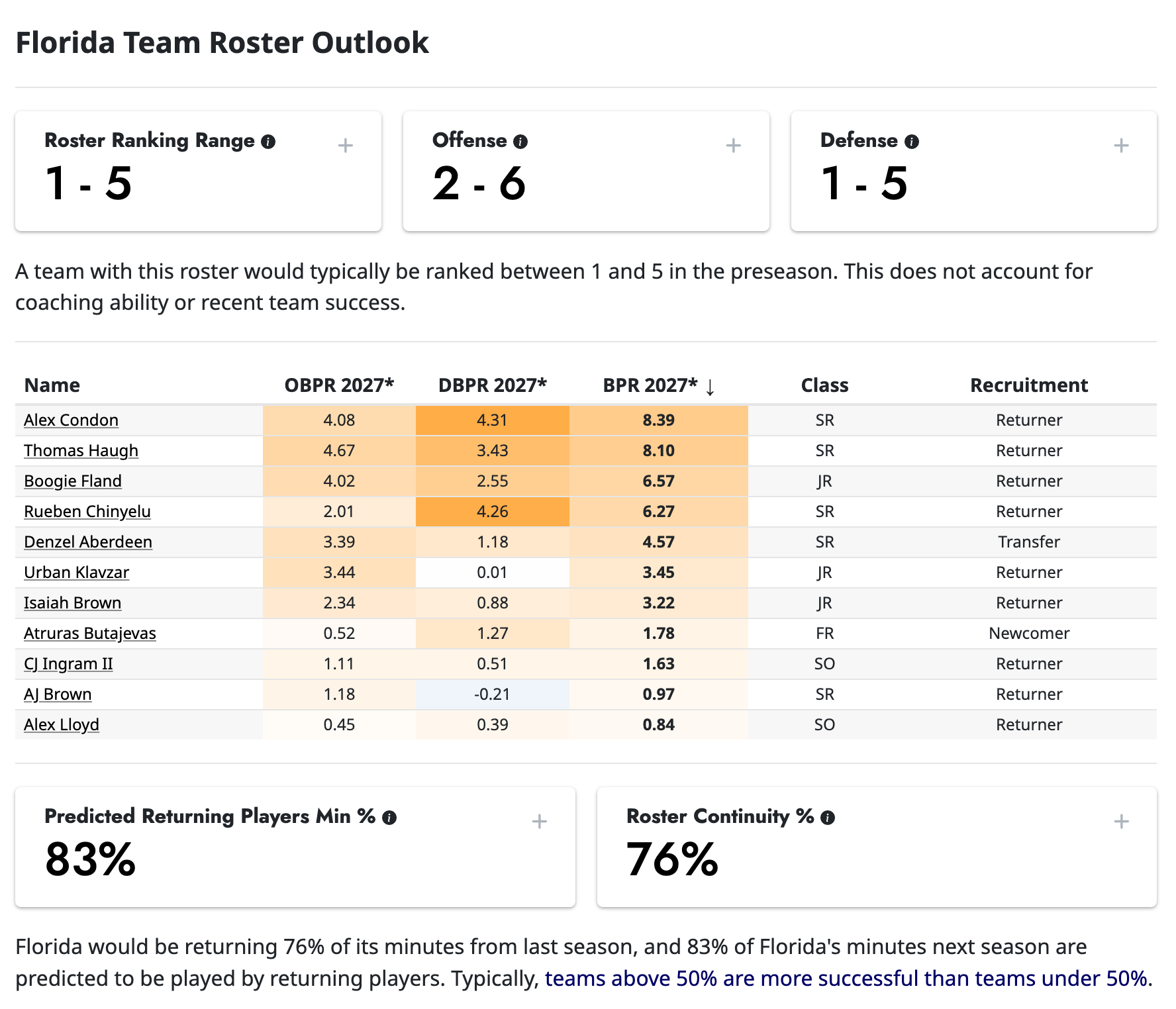
Florida is likely to be the #1 team in the AP preseason poll right now, and for good reason. They were a 1-seed and one of the four best teams last season, and they are returning almost every player from the 2026 roster. They are also adding back former Gator Denzel Aberdeen (pending a waiver). In the modern portal era, it’s frankly absurd for a team this good to be returning as much talent as Florida is doing here under Todd Golden. It’s worked for Golden before: Walter Clayton, Will Richard, Alex Condon, Thomas Haugh, Denzel Aberdeen, and Micah Handlogten all returned to Florida after the 2024 season, resulting in a national championship the following year. Next year, 83% of Florida’s minutes are predicted to come from returning players.
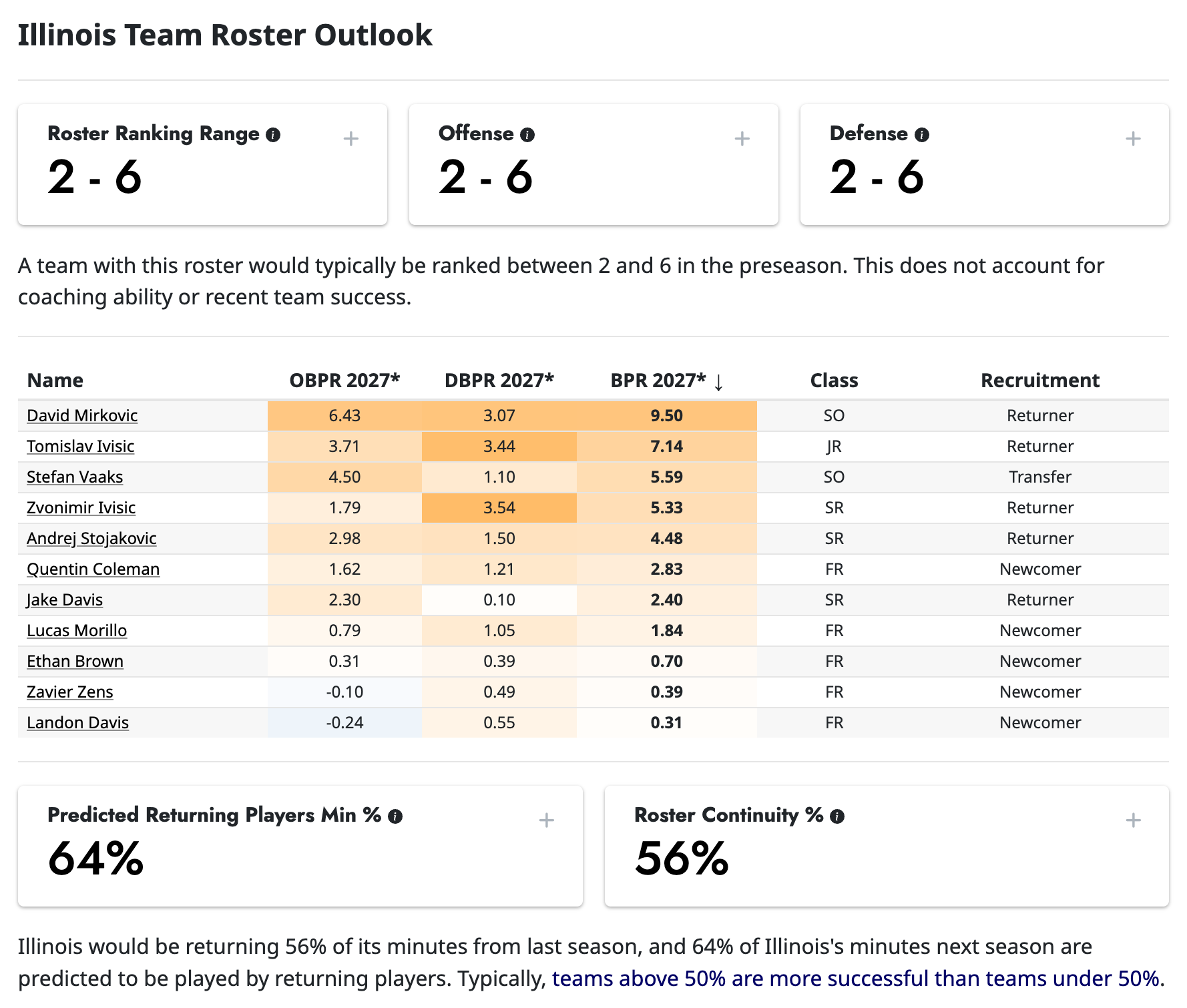
Another poster child of #TheRetention, Illinois is returning some huge pieces from this season’s Final Four team. David Mirkovic, Tomislav Ivisic, Zvonimir Ivisic, Andrej Stojakovic, and Jake Davis all played key roles in getting Brad Underwood to his first Final Four. While Stefan Vaaks will be filling in for the departing Keaton Wagler and there will be some freshmen in the rotation, 64% of Illinois’s minutes are predicted to be allocated to returning players.
Two other teams may not be top-10 locks in the preseason, but do return a very notable portion of their production from this past season: Michigan State and Virginia.
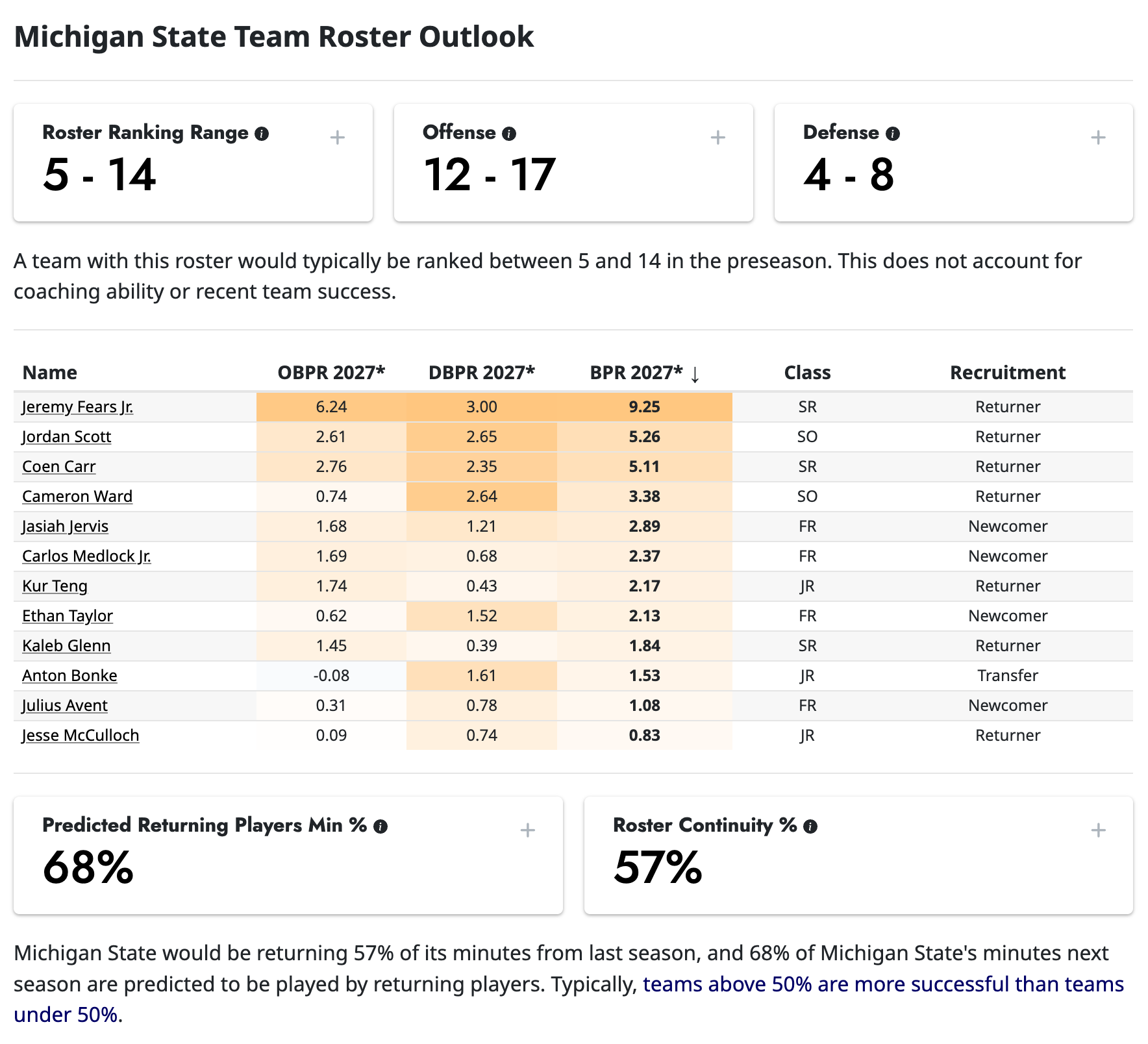
Tom Izzo getting Jeremy Fears Jr. back is huge — Fears will be in the conversation for preseason national player of the year. In addition, all four of Michigan State’s top expected players for next season are returners: Fears, Jordan Scott, Coen Carr, and Cam Ward.
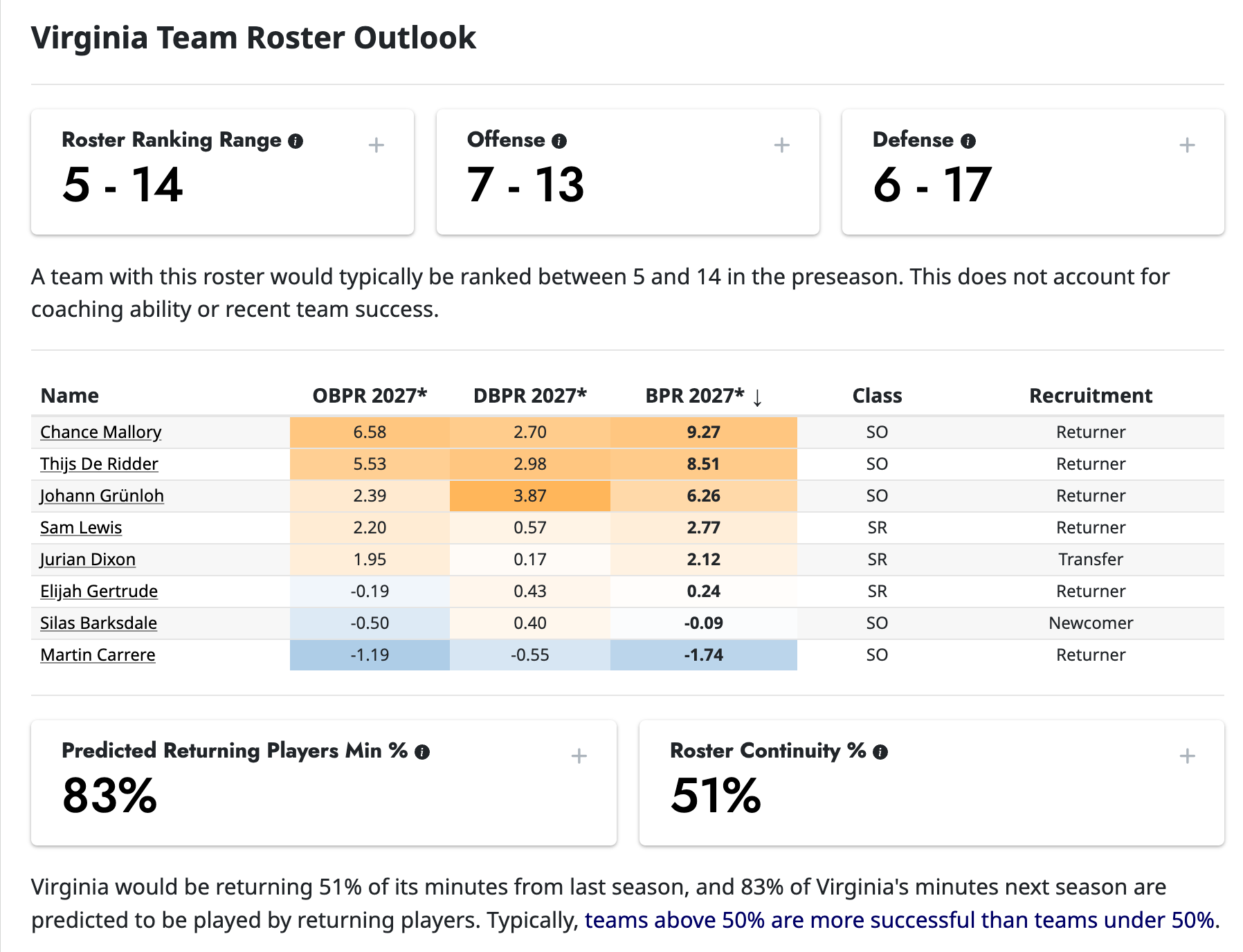
Outside of perhaps Illinois, no other team benefited as much from incoming international talent as Virginia. Most teams would covet having Thijs De Ridder and Johann Grunloh for one season — and Virginia gets them for two. With Chance Mallory and Sam Lewis returning as well, the main core of Ryan Odom’s talented squad is back. Though the roster may not be finalized yet, as things stand, 83% of Virginia’s minutes are expected to be allocated to returning players.
Further Analysis
I will be expanding on this analysis and analyzing some other portal moves over the next couple of weeks on The EvanMiya College Basketball Show. Be sure to subscribe to the podcast platforms or on YouTube!

Absolutely fascinating and outstanding breakdown of everything, Evan. Well done...again!
It's one of the featured articles in today's College Recruiting Weekly post: https://dantudor.substack.com/p/the-undecided-prospect-5-questions-5a0
Keep up the great work
I have wondered about this question for a while now. Great topic and analysis. Thanks, Evan.