


In the modern portal era, it has become increasingly difficult for programs to have sustained success over multiple years. When rosters fluctuate year-over-year, coaches can’t depend on their ability to develop players as much as they could a decade ago. Instead, the importance of evaluating talent has become more crucial than ever.
Though coaches can optimistically believe that they can get a tune out of any roster they have, team success is highly correlated with roster talent. Only the very best coaches can significantly overcome a lack of individual quality on their team.
A large part of each team’s preseason projection on EvanMiya.com comes from a Roster Talent grade I assign to each team. This grade adds up the talent on a roster by taking a weighted sum of each player's projected rating, using Bayesian Performance Rating, and accounting for which players are likely to play more minutes than others.
The graph below compares each team’s preseason roster grade with its current team efficiency rating on EvanMiya.com for the 2025-26 season. This visual shows how much teams can perform significantly above or below the expectations for their roster.
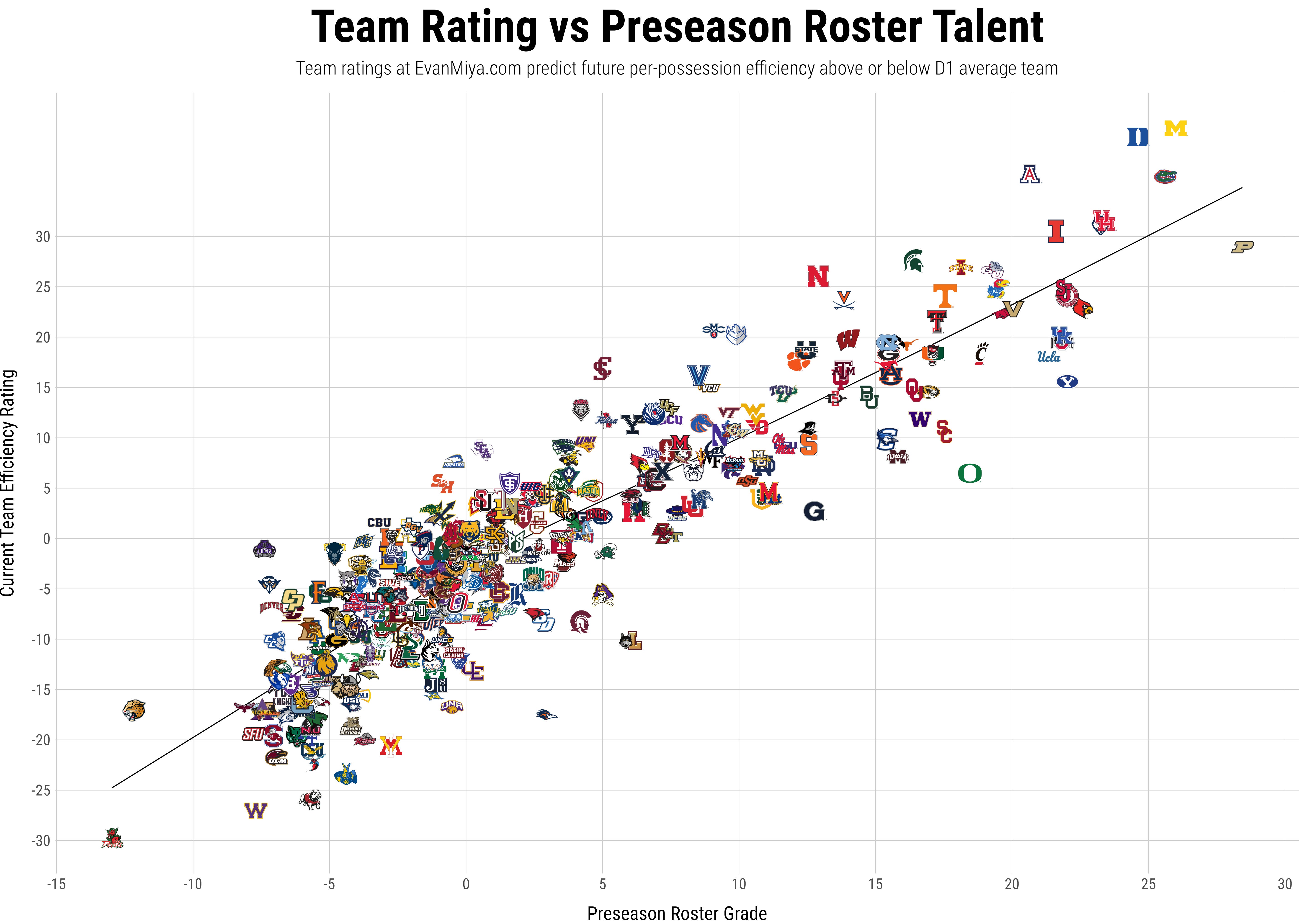
As you can probably see, there is a pretty tight correlation between preseason roster grade and how the season has panned out for most teams. In fact, around 80% of the “variation” in current team rating can be explained by the preseason roster grade. In other words, a team’s season is 80% defined by how good the roster is before the year even starts, with the remaining 20% being everything that happens after that. There are so many factors that can explain why a team’s season plays out the way it does: coaching ability, in-season player development, scheme changes, injuries, locker room chemistry, sickness, etc. Yet roster quality is by far the most important variable, and only the best coaches can consistently outperform their talent.
A team’s season is 80% defined by how good the roster is before the year even starts, with the remaining 20% being everything that happens after that.
Outperforming Roster Talent
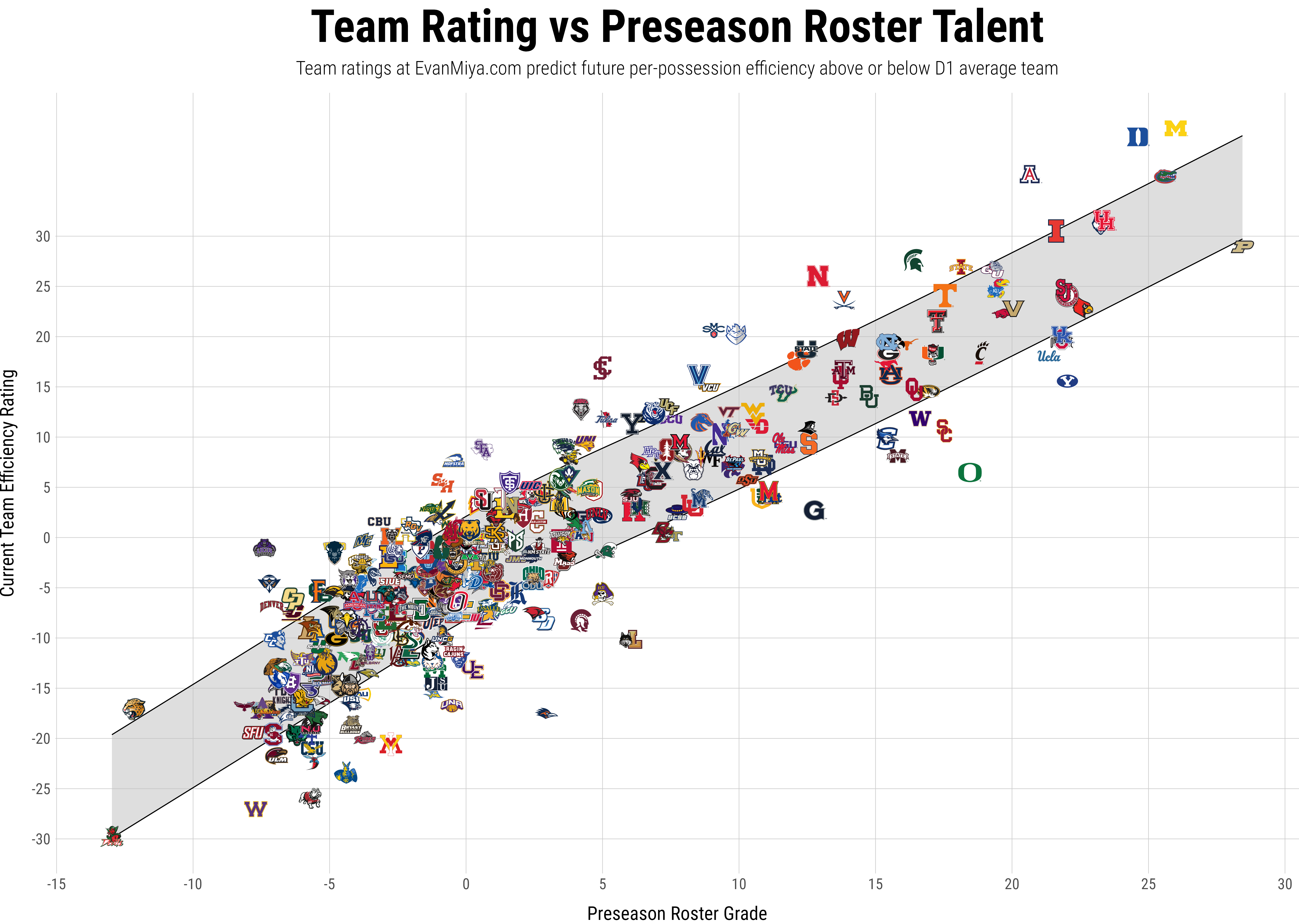
To put some more concrete numbers to this, I will define a team that has “outperformed expectations” as one in the top 15% nationally, performing better than expected given its roster talent. Similarly, a team in the bottom 15% has “underperformed expectations”.
The graph below displays these bands: If a team is above the gray shaded area, it means they have significantly outperformed expectations for their roster, and if a team is below the gray area, it means they have failed to meet expectations. Every team that falls in the gray area is in the middle 70% of teams performing within a reasonable range of what was expected of them based on their Roster Talent grade.
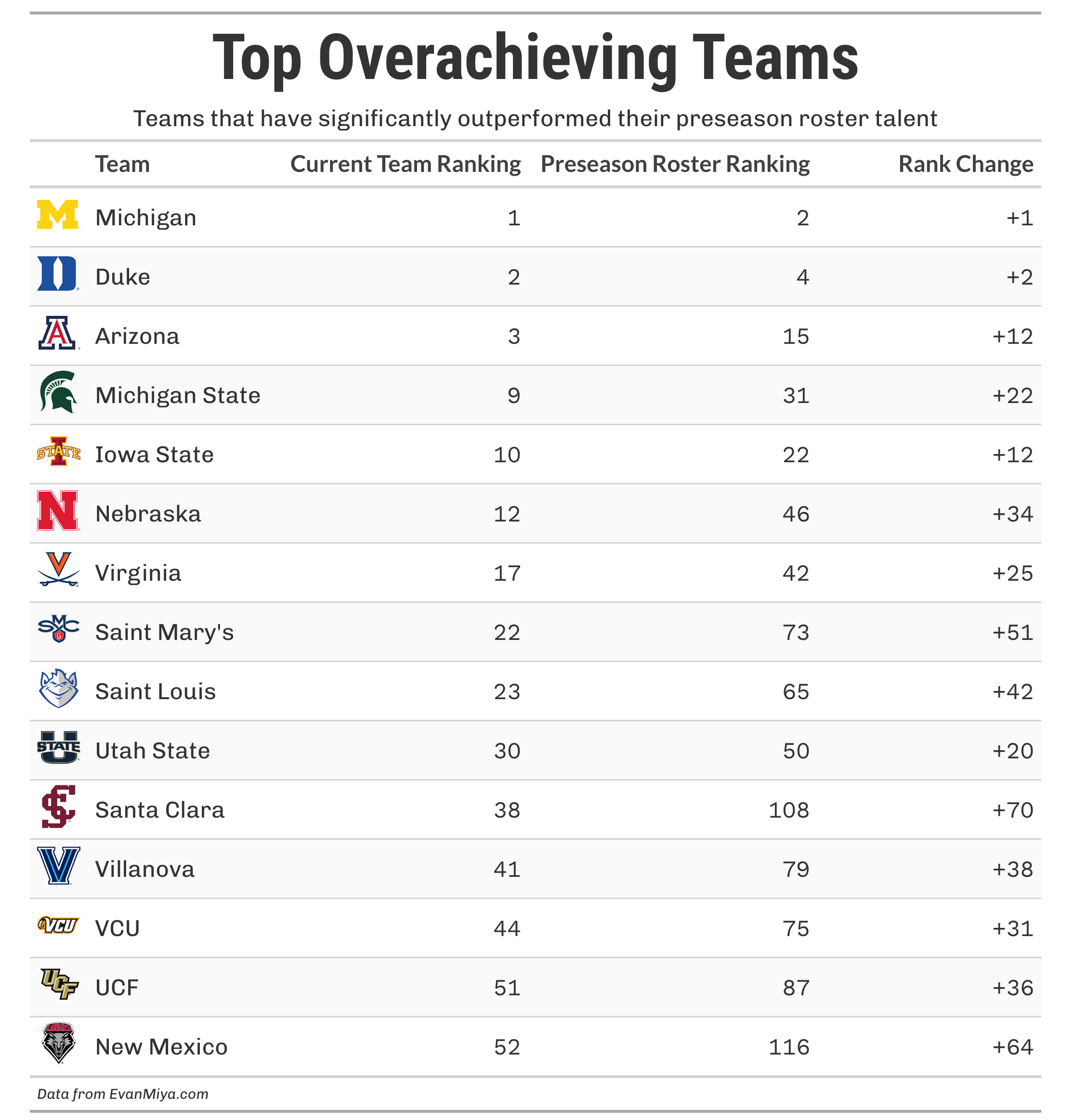
Looking at the teams likely to make the Big Dance, there are some notable overachievers, listed in the table below. Michigan and Duke qualify because, even though their rosters were top-five to begin the year, they have turned out significantly better than expected. Other national title contenders like Arizona, Michigan State, Iowa State, and Nebraska fall on this list. Both Santa Clara and Saint Mary’s out of the WCC have moved up more than 50 spots compared to their preseason roster talent ranking.
Every coach hoped, and maybe even believed, that they could be on the “overachievers” list by the end of the season. For 85% of them, being on that list didn’t turn out to be the reality. Most teams fall within the “within expectations” band, with some falling short of even that.
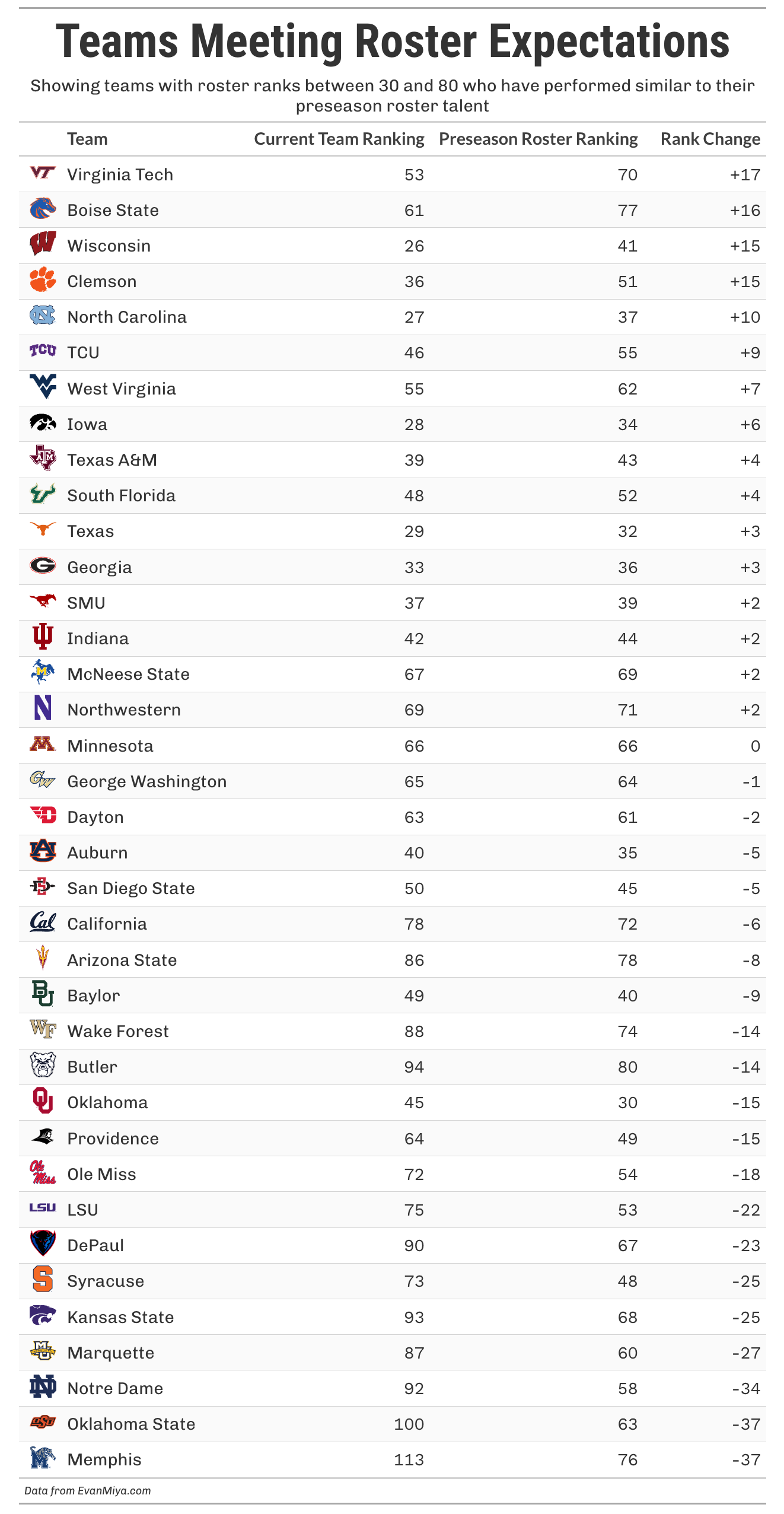
This zoomed-in version of the previous graph shows every team ranked between 31st and 80th in the preseason based on their roster talent grade at EvanMiya.com. Out of this group of 50 teams, 8 of them are labeled as “overachievers”, 7 of them are labeled as “underachievers”, and the remaining 35 are within range of where they were expected to be based on their roster talent, which represents how most teams’ seasons will go.
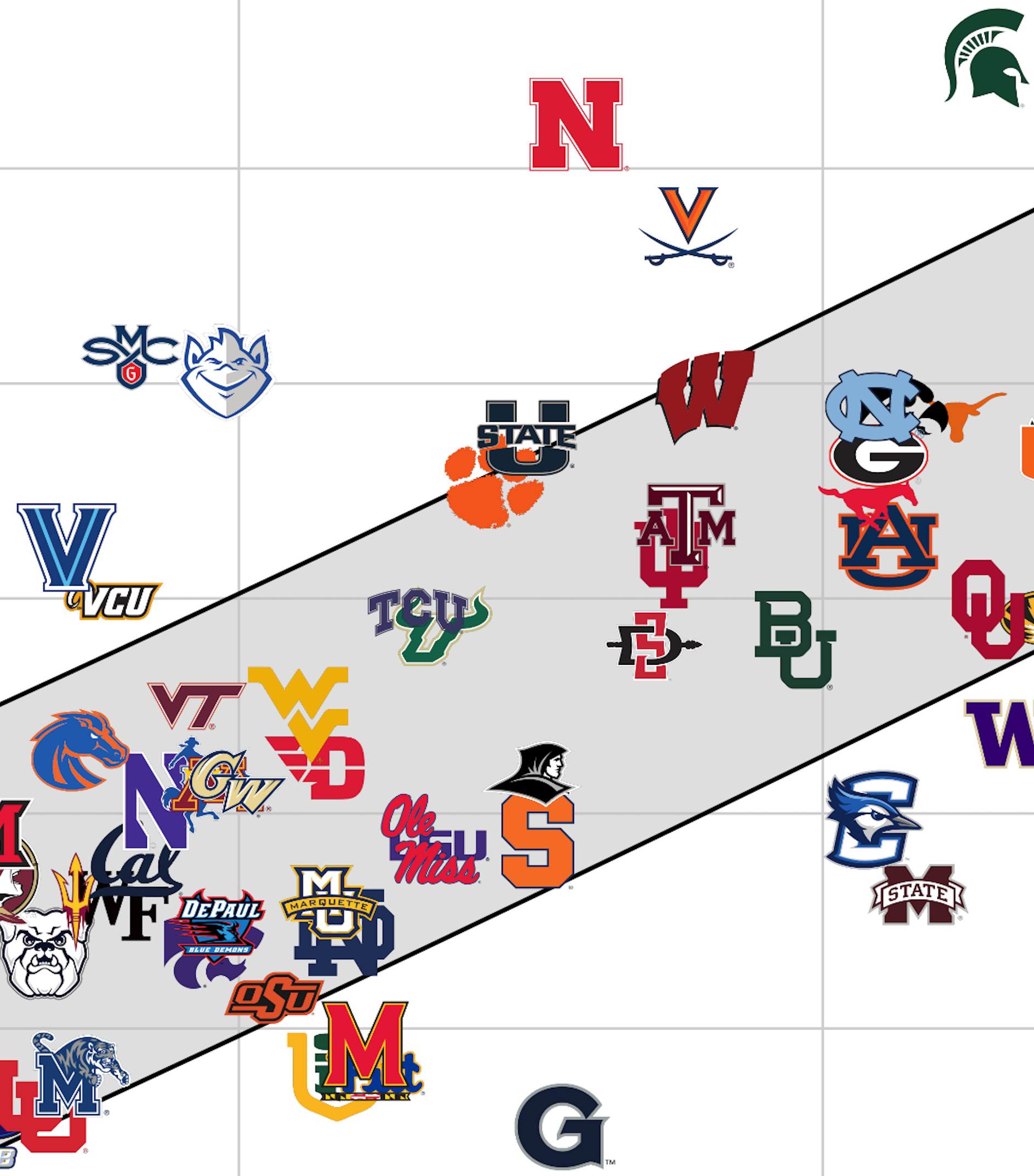
The main takeaway here is how difficult it is for most teams to end up significantly better than their roster grades, at least according to the player projections at EvanMiya.com. In fact, over half of the teams in this group are within 15 spots of their preseason roster talent ranking.
The table below shows each team’s preseason roster ranking compared to their current team ranking for those in the “meeting expectations” category.
Making Smart Roster Decisions
The importance of obtaining a quality roster is not something unique to college basketball. In every team sport, it’s almost impossible to win a championship of any kind without being among the best in talent in that pool of teams. For college hoops, that not only matters for national championships but also for conference titles.
Given how much unavoidable roster turnover there is for most teams these days, coaching staffs must have roster-building tools that help them make more accurate player evaluations. There are a ton of good ones out there, but I’ll advocate for many of the resources at EvanMiya.com that have been invaluable to teams for years. The player evaluations that teams can access on the site are the same ones that calculate these roster talent grades mentioned today. If your goal is to have a top 50 team in the sport next year, but you only have a roster talent grade of 80th in the preseason, evidence shows that you don’t have a good chance of overcoming that roster diagnosis and achieving the success you want.
There are two main product tiers at EvanMiya.com that I recommend for roster building and player evaluations. The first is the “Premium” subscription, which is available to anyone. This tier gives you projections for every player in the transfer portal, plus dedicated player skill projections pages for every Division 1 player. You can read more about the player skill projections in this previous article.
The most powerful tool I have for roster building is a new set of features I launched last year called the Front Office Suite, which is specifically designed for coaches, GMs, and ADs who want to use player projections to actually obtain NIL value estimates for every single player in Division 1. There were a bunch of notable teams, including Michigan, who signed up right after the tool launched last April and used it to help with NIL evaluations, build intelligent player searches, assess hypothetical lineup chemistry, get estimates of their roster talent, and more. If you’re interested in getting more info on this product, email me at evanmiyainfo@gmail.com or send me a direct message.
More March Analysis
I’ve got a ton of exciting March Madness content planned, with a lot of it coming on my new weekly podcast, The EvanMiya College Basketball Show! It’s a weekly podcast with episodes every Tuesday morning. The show covers national storylines and recent trends in CBB, featuring multiple guests each week — plus a touch of analytics.
There will be a new episode out tomorrow morning (Tuesday the 3rd). For new, here is the latest show from this week:
I'm surprised you enumerated the over-achievers and the achievers and skipped the under-achievers. But I guess that list is not likely to be very March relevant with a couple exceptions.