I spent a good chunk of the summer building a projections model for any player entering Division 1. The goal is to get a stats-driven prediction of a player’s impact in college before they have played a single minute of D1 basketball. These new models account for a player’s box score stats, age, level of competition, and composite recruiting rankings to more accurately forecast their freshman-year Bayesian Performance Rating.
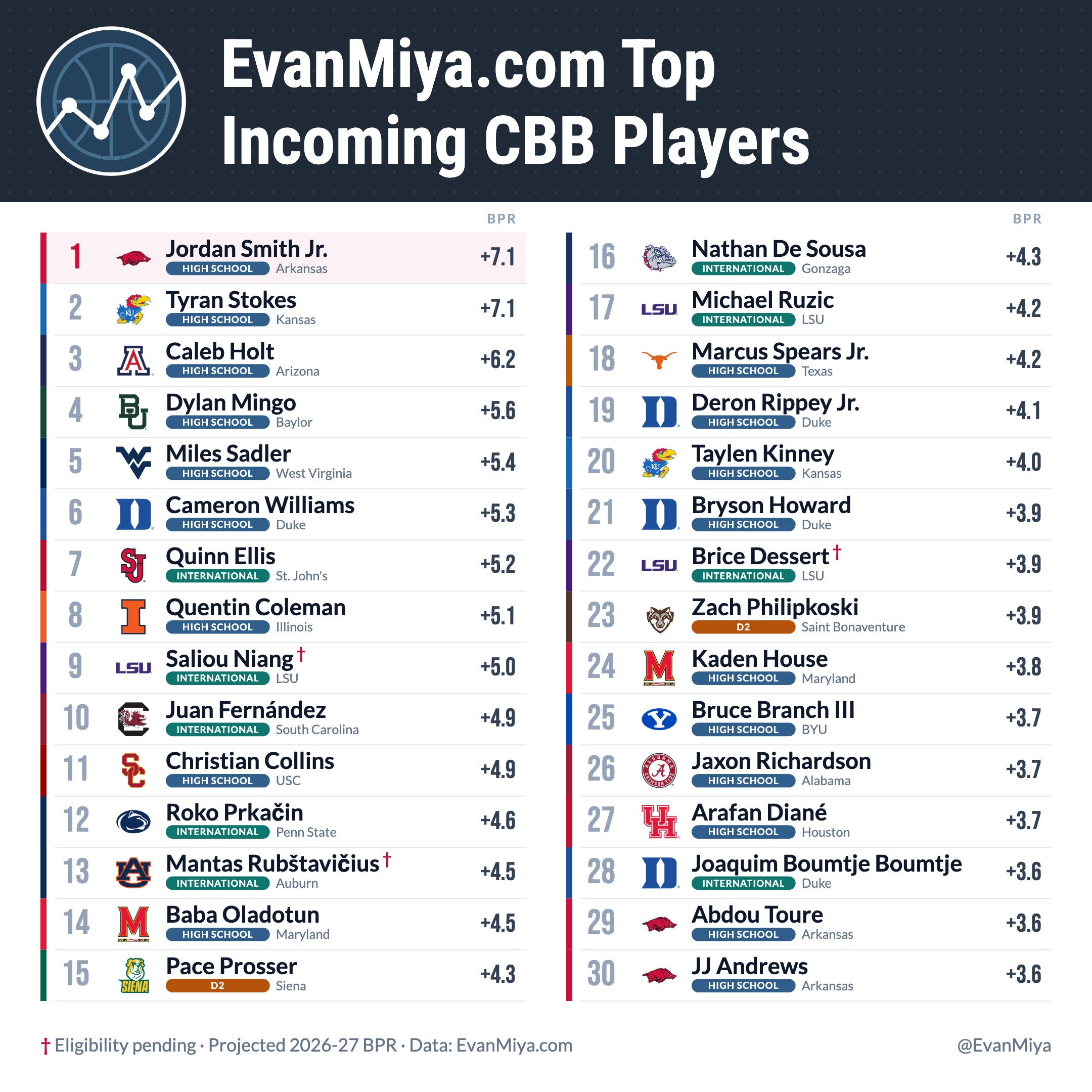
Before I explain the methodology, let’s jump right to the top 30 incoming recruits according to the new projections model:
Some takeaways:
Jordan Smith (Arkansas) has the highest projected rating of any newcomer.
Quinn Ellis (St. John’s), the top international prospect, ranks 7th among all incoming players.
Of the top 30 players, 19 are traditional high school recruits, 9 are international recruits, and 2 are Division II transfers.
Joaquim Boumtje Boumtje, the possible #1 NBA draft pick in 2028, is only 28th here (explained later in the article)
High School Projections Model
The new projections model is built specifically for three groups: traditional high school recruits, D2 transfers, and international recruits, many of whom have played professionally in Europe. Unfortunately, I don't yet have a model for JUCO transfers.
The biggest upgrade to the preseason projections for high-school players comes from partnering with Cerebro Sports over the summer, which now provides most of my high-school game and box-score data. Cerebro has a wealth of data at all levels of basketball, especially the high school and AAU travel circuits. You can find other box-score sources publicly, but it’s really challenging to collect them accurately, merge players across different competitions, and keep an up-to-date ledger of team affiliation. When working on a model like mine, where data accuracy and cleanliness are vitally important, access to this database has been huge.
Previously, my high school preseason projections were entirely based on a player’s consensus recruiting ranking. If a player ranked 8th in his high school class, his projected BPR roughly matched the average freshman-year BPR of guys ranked 8th in their class historically. This method did a reasonable job of capturing the rough expectation around a player’s talent level, but did not account at all for their individual skill set, nor was it able to differentiate between college-readiness and NBA potential, which are often mixed together in rankings from 247Sports, On3, Rivals, ESPN, etc.
Now, a player’s consensus recruiting ranking still plays a role, but more as an initial anchor for his projected rating. The 8th-best recruit in his class may start with roughly the 8th-highest projection, but that number moves up or down based on his productivity in high school games, giving more weight to recent games than to games from over a year ago.
Each box score category is also weighted based on how much it actually translates to college impact. For example, when predicting college 3PT%, a player’s three-point attempts per possession in high school is a better predictor than his actual high school 3PT%.
Level of competition is considered… to a degree. Determining the strength of opposition in high school basketball is pretty difficult, so the model makes only small adjustments for this. However, some of it is also self-selecting: players with more high-profile games against other elite players typically play more games overall. Many top recruits in a class will have more available box scores than players ranked outside the top 100.
Finally, the sample size of games available for a player has a key role in their final projection, influencing both their projected rating and the uncertainty around it. Playing more games doesn’t systematically help or hurt a player’s BPR, but it lets the model be more confident in a player’s forecast when we have more high school data on him.
The table below shows the top 25 incoming high school recruits for the 2026-27 season according to the new model, with their composite recruiting rank also shown for comparison:
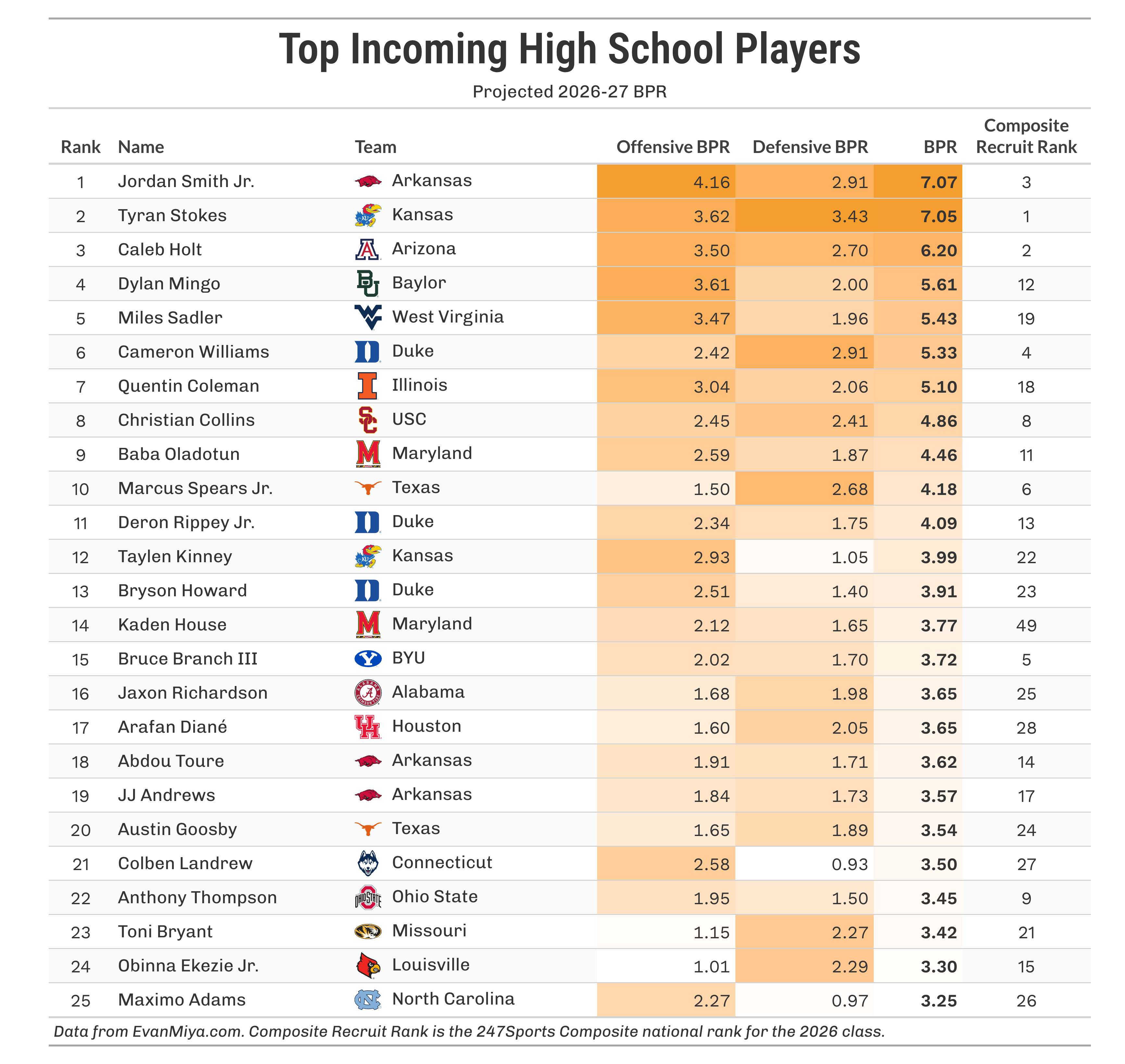
The projected ratings at the top of the class may seem low—Jordan Smith Jr. and Tyran Stokes are the only players to crack a BPR of 7.0, putting them just outside the top 30 players nationally. While it’s not unusual for the top freshman in the preseason to have a BPR around 7.0, it does illustrate that the elite talent in this year’s class is lower than in previous years.
Here’s the list of the top freshman coming into the year in previous seasons, based on how they would have been rated in the preseason using the new high-school projections model:
2025: Cameron Boozer, 9.8 BPR, #2 nationally
2024: Cooper Flagg, 10.7 BPR, #1 nationally
2023: Aaron Bradshaw, 6.2 BPR, #42 nationally
2022: Dereck Lively II, 7.1 BPR, #12 nationally
2021: Jalen Duren, 6.7 BPR, #17 nationally
2020: Cade Cunningham, 7.5 BPR, #5 nationally
2019: Cole Anthony, 8.3 BPR, #3 nationally
2018: RJ Barrett, 8.7 BPR, #3 nationally
2017: Marvin Bagley III, 8.0 BPR, #7 nationally
Jordan Smith, the top-ranked freshman this year at #34 nationally, would be the second-worst national ranking in the last 9 years. However, the actual number is more interesting to me: Smith and Stokes’ BPR of roughly 7.1 would have ranked them the 18th-best player nationally in the 2023 preseason, the 13th-best in 2022, and the 8th-best in 2021. This speaks to the crazy amount of talent we have in the sport in 2026 that wouldn’t have been playing college ball several years ago, pre-NIL.
International Projections Model
Building a model for international players was the most exciting… and by far the most challenging of the three. A player’s box-score stats in professional leagues abroad tell only part of the story. Team prestige, domestic league, continental competitions, and playing time matter arguably as much as raw production.
There are a few components that go into the international model:
Box score production: I have a version of Box BPR (my college-trained version of a box-plus-minus model, which uniquely weights stats based on what leads to Division 1 success) that generates offensive and defensive value from box scores, going back several seasons. This is not enough, though! Any model that rates international players based only on box-plus-minus misses key context.
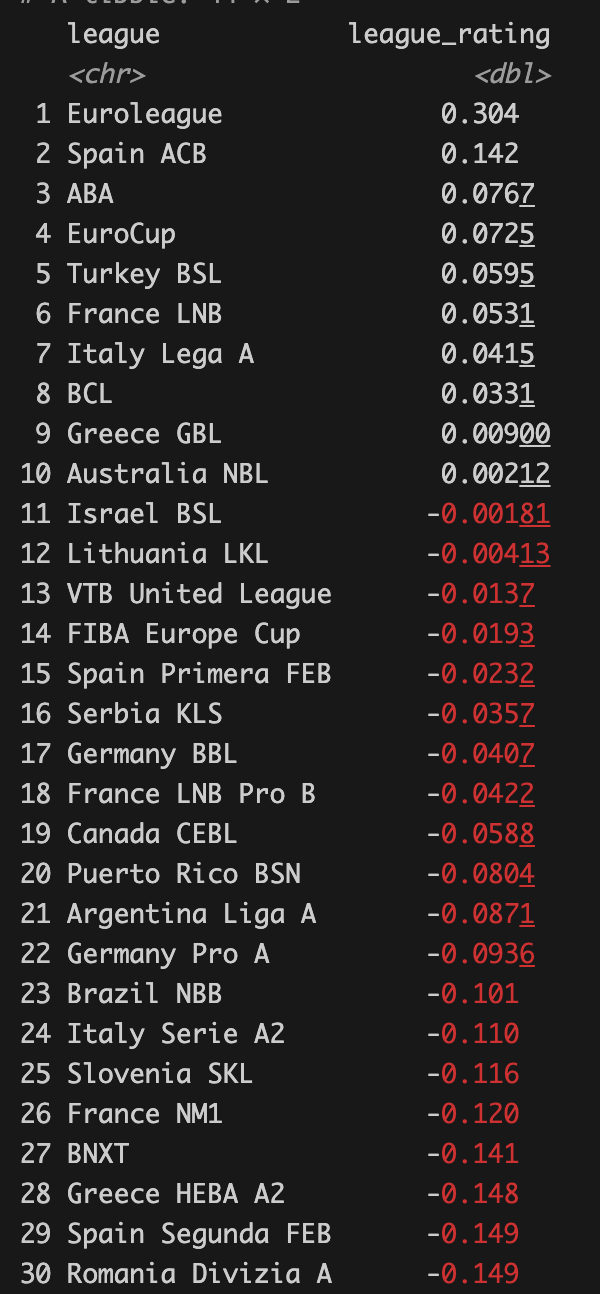
Level of competition: Every professional team from the more notable international leagues is put on a global scale based on its domestic league performance, its continental competitions, and how player performance changes when they move teams. All of these factors are important in getting a stable understanding of team strength and league prestige1. A player who is logging 10 minutes per game in the Euroleague will typically be much better than someone scoring 25 points per game in France’s second tier.
Prospect signal: Some younger international prospects have massive college and NBA potential despite not logging many career minutes on a senior team professionally. International standouts last season like David Mirkovic, Mario Saint-Supery, Neoklish Avdalas, and Ivan Kharchenkov were all younger than 20 when they entered college and had varying degrees of senior-team success in Europe before Division 1. To better capture their potential, I use a “prospect signal” metric I calculate for every player. I won’t give away exactly how it works, but it looks at how young they were when they first achieved international success and how promising their early play was. One thing this currently lacks is FIBA data, which I hope to add in the future and would be an additional useful piece for younger players.
Model training: I built this model using the BPR production levels of previous international recruits who have played in college recently. There’s one problem: the list of international recruits with verifiable Division 1 experience is still pretty small. I have around 250 players who qualify from the previous five years or so. As such, the model still needs a lot of improvement as we add more data in the coming years.
Here are the top 25 incoming international players according to the new model:
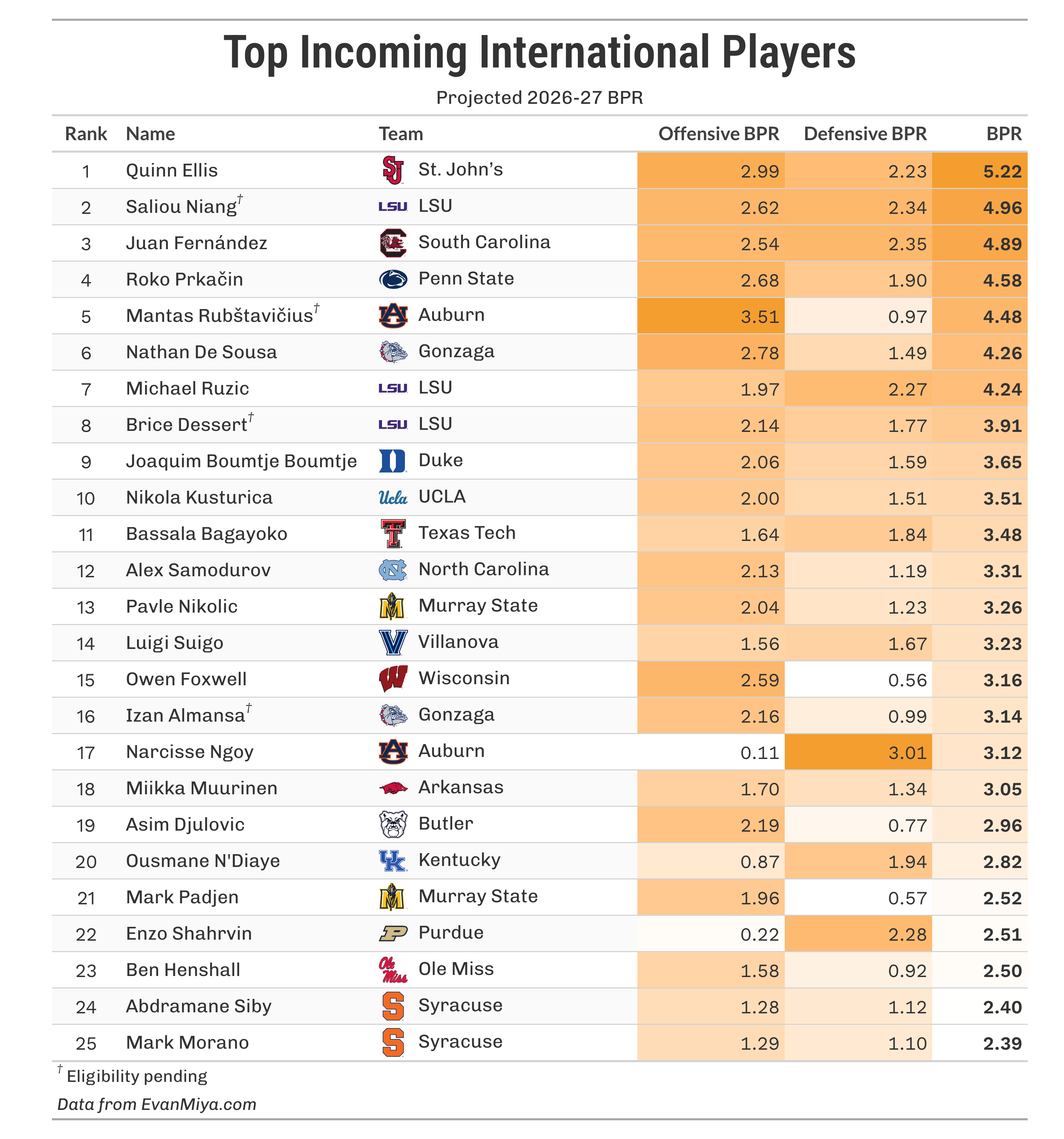
Last year, the new model would have shown five international players above a 4.0 projected BPR: Thijs De Ridder, Sananda Fru, Mario Saint-Supery, Johann Grunloh, and Hannes Steinbach. All five finished in the top 125 players by season's end, with David Mirkovic finishing higher than any of them at #43. This year, we have seven players above 4.0 in the preseason, assuming Niang and Rubstavicius become eligible.
A note on Joaquim Boumtje Boumtje and Nikola Kusturica: Both are currently in the conversation for the top NBA draft pick in 2028 after two years in college. Because they are so young (both are 17), they don’t have much senior-team experience yet in Europe, and very few international players from previous seasons even remotely match their exciting prospect profile. If one of them becomes a top-100 player this year (which could easily happen if they are as advertised), future players like them will benefit from having their first-year college success recorded in the database.
Division 2 Transfers Projection Model
The D2 projections model was the easiest of the three model types to build. We have a wealth of D2→D1 transfers from previous seasons to train the model, and I have as much data for each D2 player as I do for any D1 transfer. The model components are as you’d expect: box score production from previous seasons, team strength, level of competition, expected development based on age, and how all of that has translated in previous seasons for transfers who have made the jump from D2 to D1.
What surprised me the most is how good the top projected D2 transfers are! The table below shows the top 15 projected D2 transfers this season. A BPR above 0 represents a player who is expected to be better than an average D1 player this year:
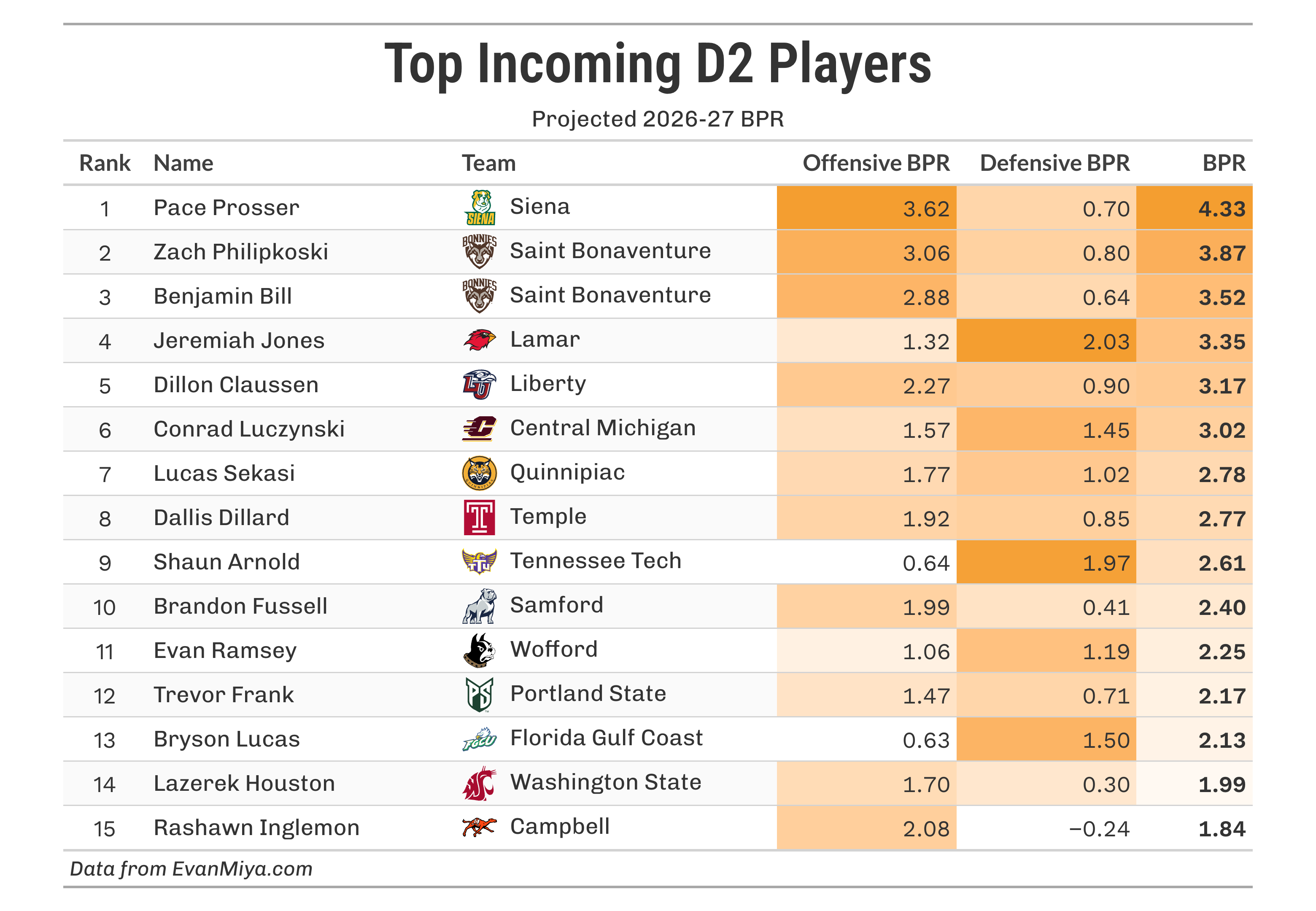
The top D2 transfer is Pace Prosser (Siena), whose projected BPR of 4.3, which ranks 15th among all D1 newcomers, and is inside the top 250 players nationally. Saint Bonaventure has two more D2 transfers with a BPR above 3.5, both in the top 350 in the preseason. All three were in the top-10 in Division II Box BPR last season.
Many Division II transfers have found immediate success after moving up a level. Last year, 7 D2 transfers finished the year with a BPR above 3.0, led by Elyjah Freeman (Auburn), Jadin Booth (Samford), and Wes Enis (South Florida). For context, a BPR of 3.0 was around the average rating for an ACC rotation player last year.
In the 2025 preseason, 5 Division II transfers had a projected BPR of 2.0 or better (Elyjah Freeman, Wes Enis, Jeremy Dent-Smith, Chris Terrell, and Caleb Van De Griend). This year, a whopping 13 are above 2.0!
This is probably the most consequential takeaway from this analysis: more teams need to look at Division II transfers. A litany of high-major teams would love to lock in a transfer with a BPR of 2.0 or better, yet none of these top D2 transfers are headed to the power conferences.
Player Profiles
For any new D1 players, you can view their individual skill grades and projections based on their incoming stats at EvanMiya.com. Each player’s overall, offensive, and defensive grades are there, along with four main categories: scoring, rebounding, playmaking, and court impact (how much value they add beyond the box score, which we won’t estimate till they start playing in college).
Here is Tyran Stokes’s profile for Kansas:
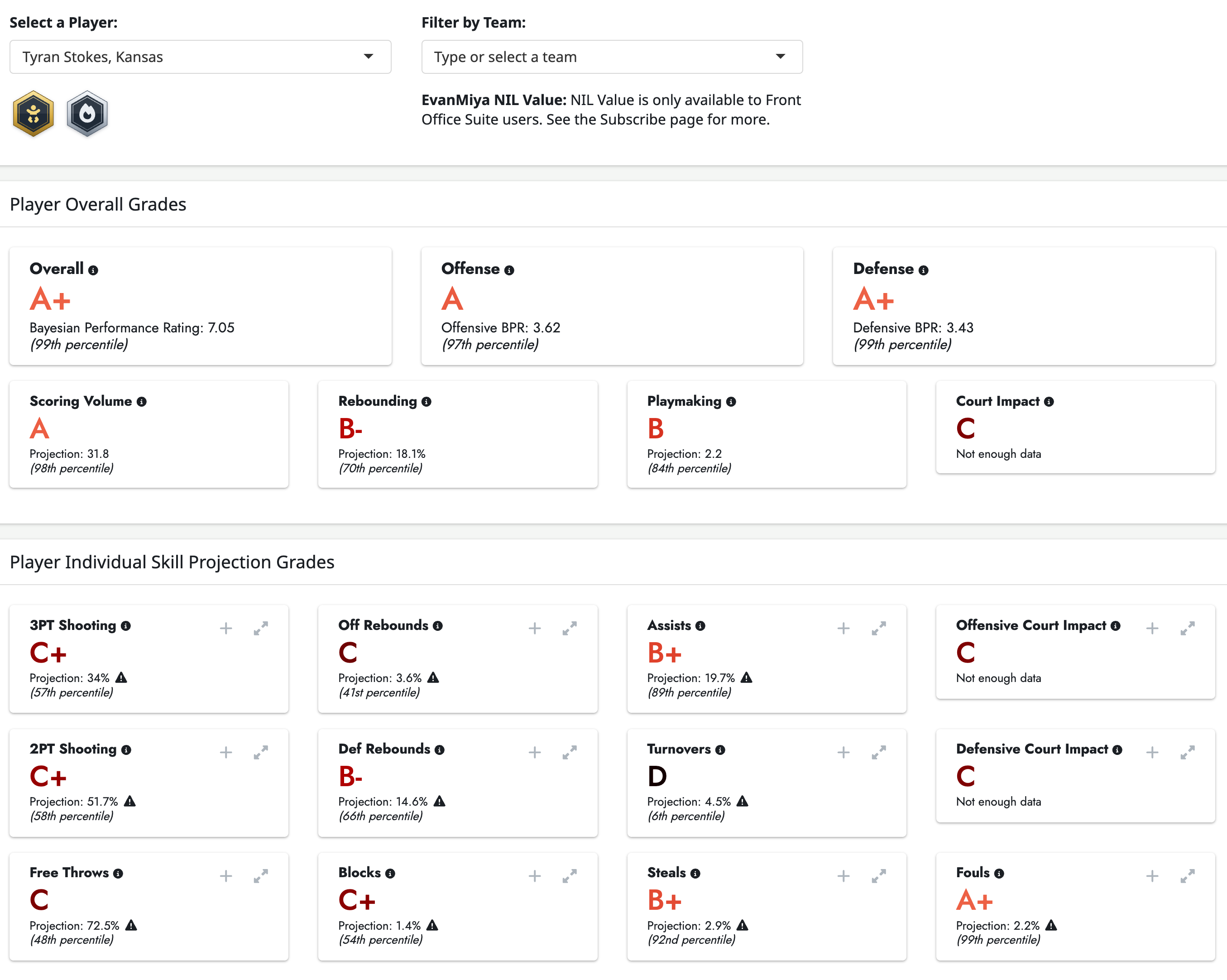
Stokes is expected to be one of the nation's more prolific scorers this year, with projected scoring volume per 100 possessions in the 98th percentile. He also ranks highly in projected assist and steal rates.
Lineup Projections
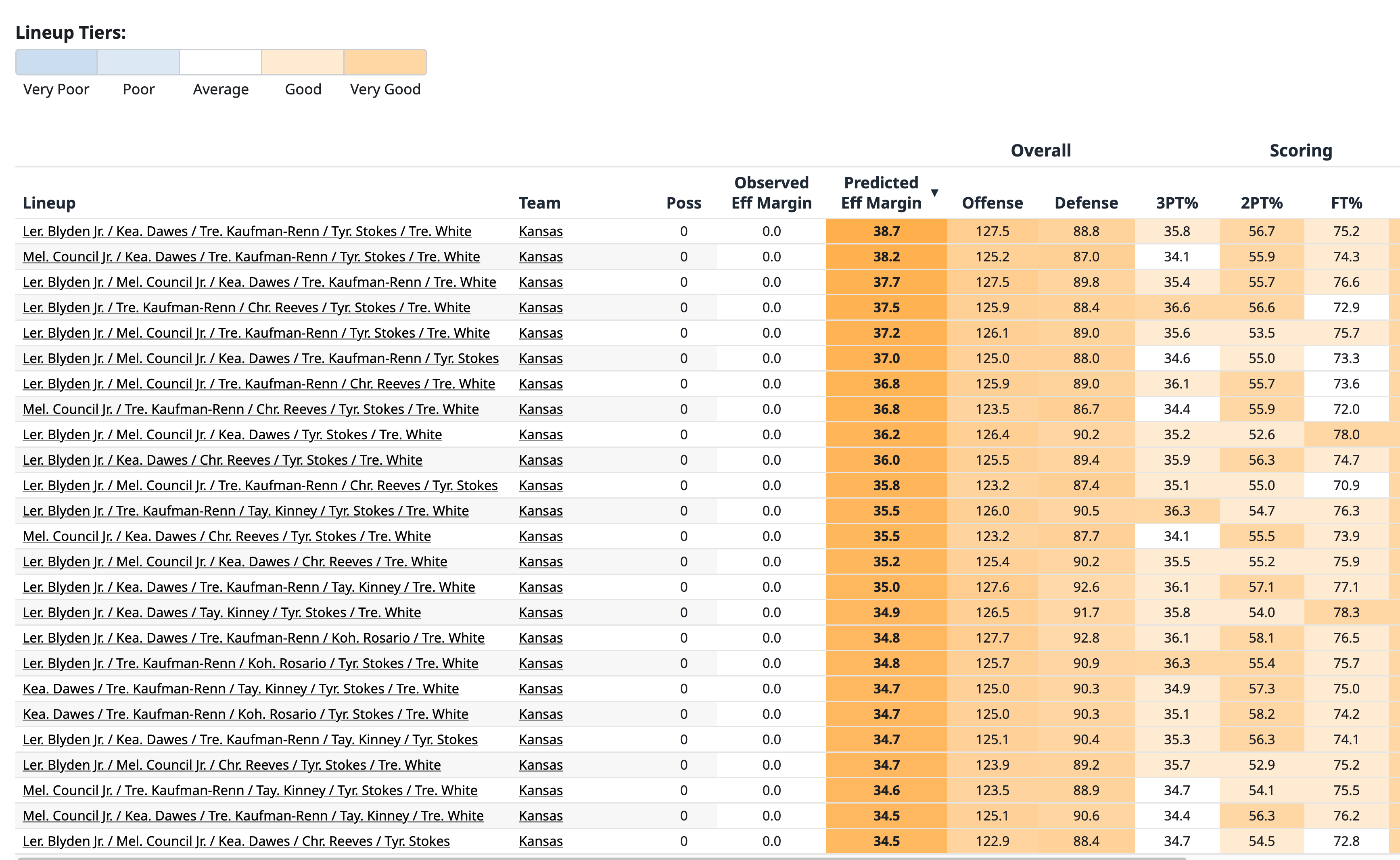
You can also view each team’s top preseason lineups based on predicted offensive and defensive efficiency for each group. You can read more about how these projections work here, but in essence the model looks at individual talent in a hypothetical unit, the group's strengths and weaknesses, lineup positioning, role balance, and other factors.
Here are the Jayhawks’ top predicted lineups (with the recent addition of Trey-Kaufman-Renn):
Future Recruiting
I’m currently building a full set of recruiting tools for EvanMiya.com that will show live recruiting rankings and projections for incoming players in future classes. Each eligible high school, international, or D2 player will have a projected rating and individual skills profile. I’m still ironing out which parts will be available in which subscription plan, but if you are a staff member on a team with access to the Front Office Suite, you'll have it all. I’m also finishing up an API product that will be available soon, included for free in the Front Office Suite.

Here is my model’s assessment of the quality of the top 30 international leagues in the 2025-26 season: