


In the golden age of the transfer portal, a new commodity has emerged: international recruits playing professional basketball. There was a two-month period last summer where it seemed like every high-major program in the country was signing some player from Europe, hoping they would have an immediate impact. The 2024-25 season featured a handful of international recruits expected to make big contributions in Division 1, including Kasparas Jakucionis, Egor Demin, and Fedor Žugić. This season, that number is closer to 75 international players with professional experience.
Many programs followed the herd in a sudden rush to pan for gold that seemed to appear out of nowhere. The question is: did many of them actually strike it?
In this article, I’m going to present the stats on production from international recruits to assess their effectiveness.
For the sake of this discussion, I am focusing on one group: international players with prior professional basketball experience who are in their first season of Division 1 college basketball. This does not account for international transfers who have already played a season in college (Matas Vokietaitis transferred from FAU to Texas), nor am I considering players who are not native to the US but were ranked by recruiting services like 247Sports well before the summer of 2025 (Dame Sarr is an example). I’m specifically interested in international recruits who received offers to play in college during the past offseason. My list of international players will not be exact, but it is very representative of the overall crop we’ve seen enter college basketball this season.
Most Productive First-Years
I think the easiest way to evaluate the effectiveness of these international imports is to compare their production to the rest of the “traditional” freshmen class. For much of this study, I’m using Box BPR as the measuring stick of productivity. For those who are unfamiliar with Box BPR, it’s a college version of Box Plus-Minus that looks at your individual box score statistics and quantifies how valuable a player you are based on your stats alone.
The table below ranks the top 30 first-year players in college basketball according to Box BPR. The ten most productive first-years are all traditional freshmen, but seven of them were international recruits this offseason.
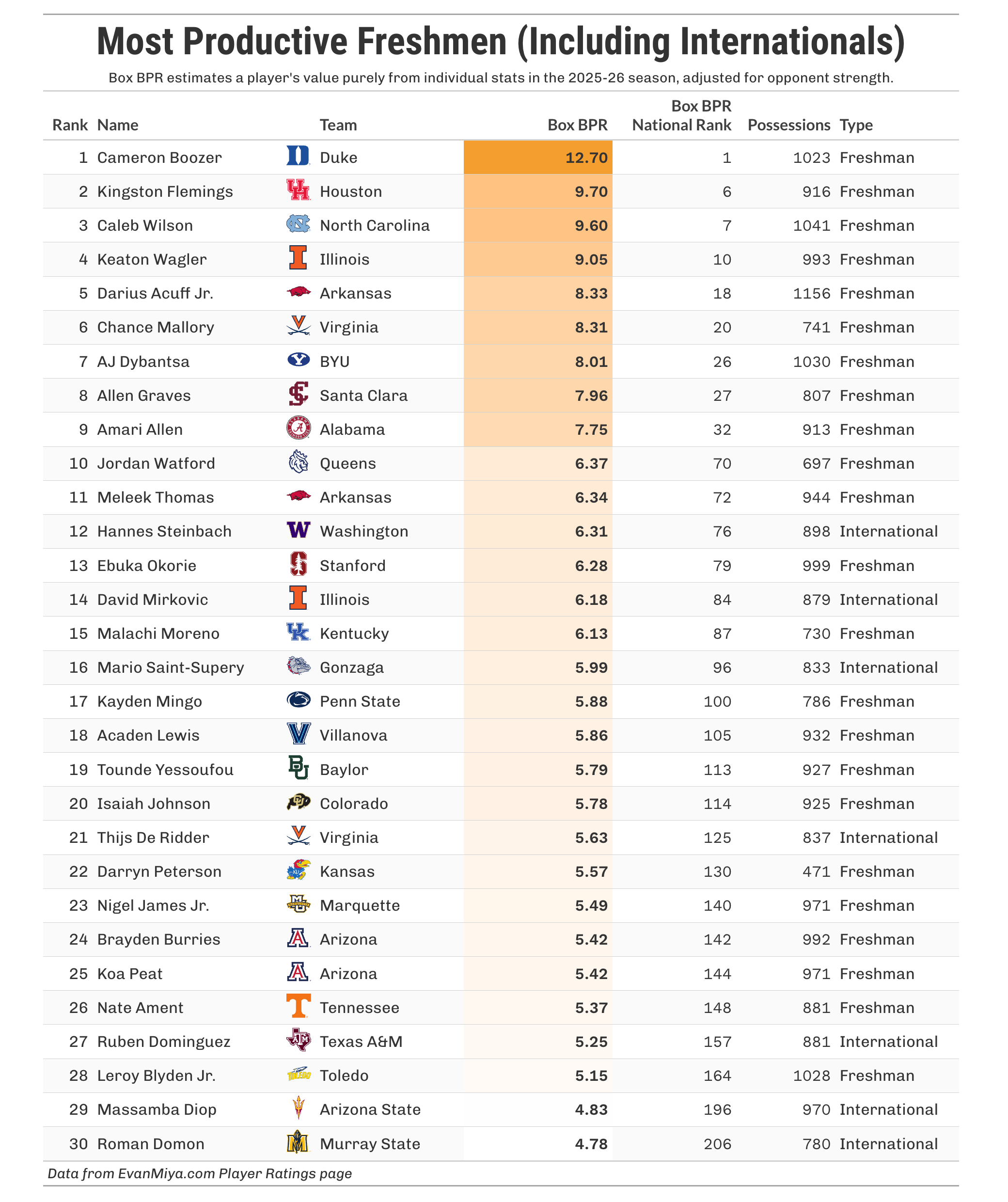
Most of the standout international guys are on this list, including Hannes Steinbach, David Mirkovic, Mario Saint-Supery, and Thijs De Ridder. Other notable names aren’t that far behind, such as Johann Grünloh, Ivan Kharchenkov, and Sananda Fru.
Comparing Freshmen and Internationals
If we compare the overall validity of recruiting international freshmen as opposed to getting traditional freshmen, how do these two groups stack up?
If you take the top 50 most productive freshmen this year, the average Box BPR of that group is +5.1. For context, the entire SEC conference has about 30 players with a Box BPR above +5. That’s a very good mark for a group of 50 freshmen. By comparison, the top 25 most productive international first-years have an average Box BPR of +3.2. You have to whittle the international list down to just the 11 most productive players to match the average level of the top 50 traditional freshmen. Basically, only the top 11 international recruits have been as productive as the top 50 traditional freshmen. That list of 11 internationals is, in order: Hannes Steinbach (Washington), David Mirkovic (Illinois), Mario Saint-Supery (Gonzaga), Thijs De Ridder (Virginia), Ruben Dominguez (Texas A&M), Massamba Diop (Arizona State), Roman Domon (Murray State), Sananda Fru (Louisville), Johann Grünloh (Virginia), Ivan Kharchenkov (Arizona), and Stefan Vaaks (Providence).
Only the top 11 international recruits have been as productive as the top 50 traditional freshmen.
I’ll take this a step further. The dream for many of the high-major teams that pulled the trigger on an international pro this summer was to find themselves a hyper-productive player out of thin air. For most teams, if that was their goal, they have been disappointed.
If you take the top three most productive players on each power-conference team this season, according to Box BPR, there are 25 traditional freshmen on that list. This means that 25 traditional freshmen are a major driving force behind their team’s success this season. The list of those freshmen is below:
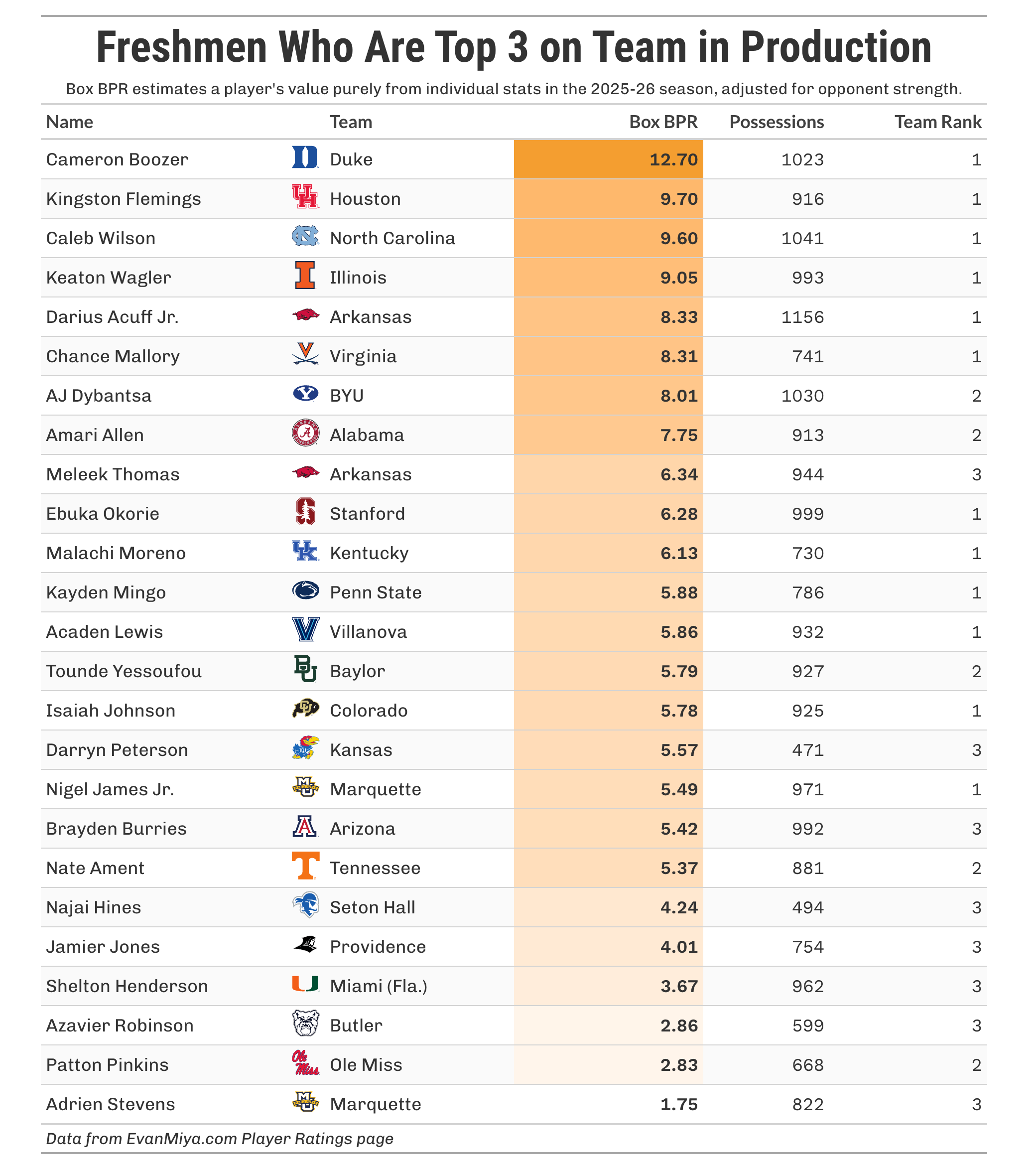
In comparison, there are just nine international first-years who rank in the top three on their own team in production among the big five conferences. By my count, that means 31 other internationals are playing for high majors that have not moved the needle on a national level in a significant way.
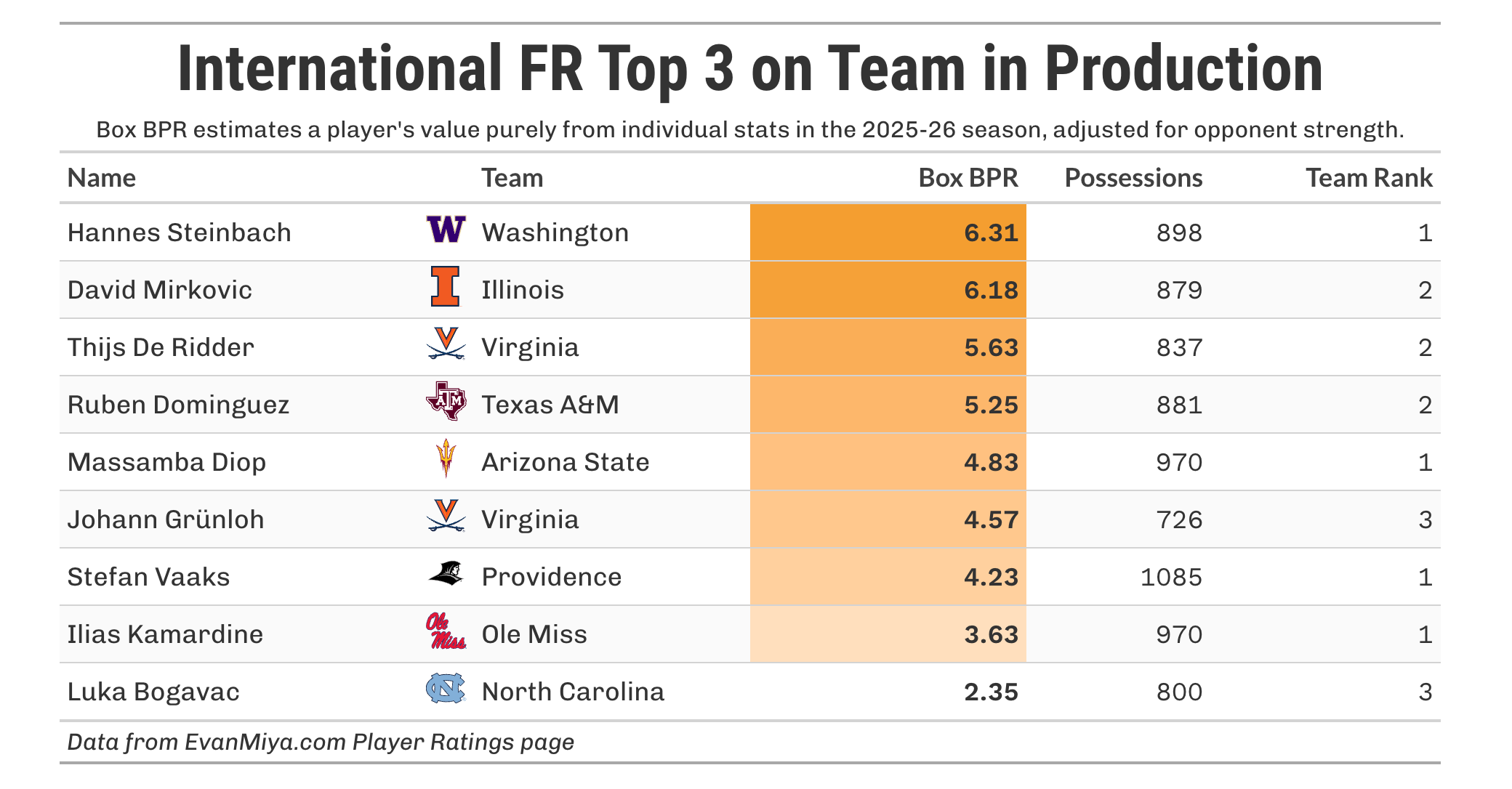
I bring all this up to offer a word of caution: When we get to the bright lights of March Madness, many color commentators and studio analysts will point to the incredible talent on display that has come from an influx of international professional talent, and rightfully so. But for every Thijs De Ridder that we praise, several other international guys have faded into anonymity that people will quickly forget about. The hit rate on these players is not anywhere close to automatic.
If you look at the top 50 most hyped international players coming into the college basketball season, according to different recruiting services and analysts, more than half of them this year have had pretty lackluster statistical output. In fact, 28 out of the 50 have a Box BPR that currently sits outside the top 1500 players in the nation. Of course, some of these players still play important roles for their teams, but they have not been lighting it up like some may have hoped.
Here is the full list of international first-years who got some offseason buzz that are outside the top 1500 in Box BPR, in alphabetical order: Achille Lonati (Saint Bonaventure), Andrej Kostic (Kansas State), Andrija Jelavic (Kentucky), Dominykas Pleta (Iowa State), Efe Demirel (Grand Canyon), Ege Demir (Oregon), Elias Rapieque (Kansas State), Evan Boisdur (Grand Canyon), Harun Zrno (Rutgers), Ian Platteeuw (Davidson), Ilia Ermakov (Saint Bonaventure), Jeff Nwankwo (Oklahoma), Jordi Rodriguez (Cincinnati), Lefteris Mantzoukas (Oklahoma State), Mantas Juzenas (Saint Mary’s), Mathieu Grujicic (Ohio State), Mihailo Petrovic (Illinois), Musa Sagnia (NC State), Ognjen Stankovic (Akron), Omer Mayer (Purdue), Paul Mbiya (Kansas), Ron Zipper (LSU), Sidi Gueye (Arizona), Tama Isaac (UC Irvine), Tibor Mirtic (Penn State), Timotej Malovec (Miami (Fla.)), Vangelis Zougris (Louisville), Yohann Sissoko (Florida Atlantic).
Are International Recruits Meeting Expectations?
I’ve left full Bayesian Performance Rating out of the conversation until now for a reason: I had to make projections for all of these international recruits before the season started. Based on recruiting ratings, statistical data, and predictions from many sources about these players, I made a judgment call on how good I thought all of these international first-years would be. In general, I was VERY conservative with these projections. I was criticized by several people for not being bullish enough on how impactful this crop of internationals would be.
In the end, these projections were too pessimistic on some of the players, but a majority of the international first-years have been even worse than where I slotted them in the preseason. The table below shows the current Bayesian Performance Rating of all the international recruits this year, from best to worst. In addition, you can compare their current rating to what their preseason projection was, and see if their ranking among all freshmen has moved up or down since the year started.
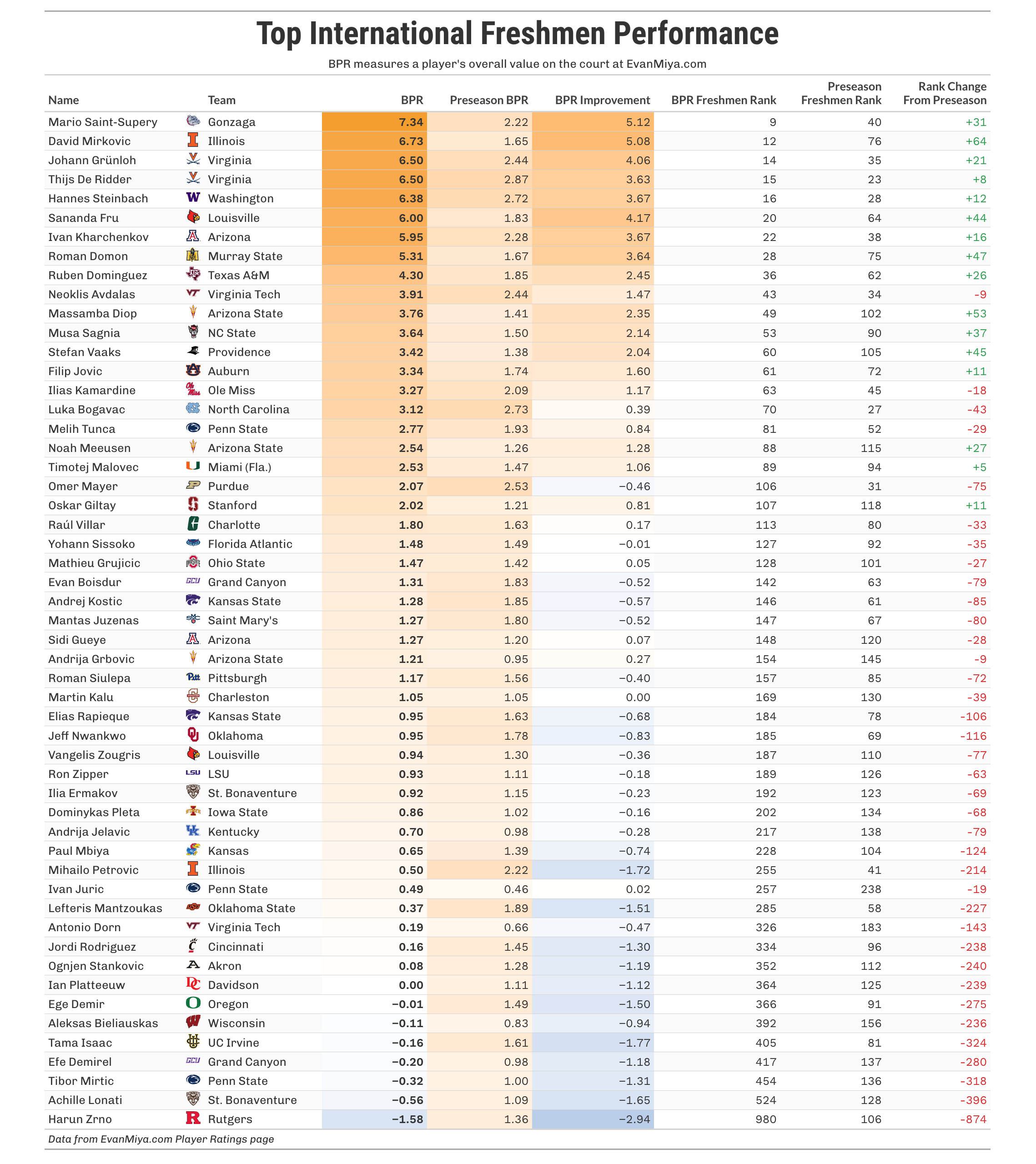
Of the 53 international first-years on this list, only 16 of them (30%) have improved their ranking among all freshmen since the year began. The vast majority of them have been worse than I projected. Players like Mario Saint-Supery, David Mirkovic, Johann Grünloh, Thijs De Ridder, and Hannes Steinbach have been outstanding. The same can’t be said about most of the rest.
There is a big difference in quality between the top international first-years and many of the rest. Teams like Virginia, who scouted well and put the right resources forward to get the quality players, have been well rewarded. Other teams that hoped for similar results but didn’t evaluate overseas talent well have been left wanting more. This analysis reinforces the importance of good scouting and evaluation.
If you want more analysis, I have a new platform this year: The EvanMiya College Basketball Show! It’s a weekly podcast with episodes every Tuesday morning. The show covers national storylines and recent trends in CBB, featuring multiple guests each week — plus a touch of analytics.
Here is the latest show from this week, with Jeff Borzello from ESPN:
Very interesting, Evan. Thank you! As an Illinois fan myself, we (as a fan base) are very interested in how the international recruiting fares seeing as how deep the eastern European roots are that Brad Underwood and staff have been establishing.
I know this information is not publicly and/or readily available, but it would definitely be interested to see money as part of this equation (just as far as expectations vs performance). For example, as far as I am aware, Illinois was the only NCAA in on the David Mirkovic recruitment, so seeing him appear 14 on that list seems notable to me...surrounded by players with multiple multiple high major offers (Keaton Wagler notwithstanding).
Thanks for the great care you put into your write-ups...they are an enjoyable read every time!
Although Andrej Stojakovic (son of Peja) was born in Greece, he essentially grew up in the US and attended high school (all four years) at Jesuit HS in Carmichael, CA. Regardless of which year he transferred, he should most assuredly not be considered an international transfer—he is a product of the US high school system.